
Nurses' career astrology is a structured way to examine birth-chart and numerology calculations with the aim of making a clearer work decision. A nurse choosing between shifts, specialties, or a move away from bedside care needs more than a personality label. The useful question is what you can test in your actual working week.
- Astrology career for nurses is a reflection tool, not a prediction of specialty fit, promotion, or burnout.
- Astrofluence career readings pair repeatable chart and numerology calculations with questions about direction, work rhythm, money, and timing.
- Compare a chart prompt with your schedule and workplace evidence before acting on it.
- Choose one small work test you can complete by Friday in 2026.
Why astrology career guidance matters for nurses
Nursing career choices involve work you can name: a shift pattern, a specialty, a charge role, or a plan to leave bedside care. Each option changes something concrete about your day. The guide to astrology for career decisions is most useful here when you bring one decision to the reading rather than asking which job the chart has chosen for you.
The calculation and the meaning are separate. Your birth details produce chart placements; your birth date produces a numerology calculation. Neither calculation measures your competence, your health, or the conditions on your unit. Use the result to write a better question, then answer that question with workplace evidence. In 2026, that evidence can be as simple as a schedule, a written offer, and notes from recent shifts.
Name the work decision before you open a chart
Start with the choice sitting in front of you. If Monday feels impossible, identify whether the issue is the shift, the workload, the manager, or the work itself. Those are different decisions. A chart cannot sort them out until you state what you are comparing.
Write the choice so you can test it. Instead of asking whether you should stay in nursing, ask whether you want to request a different schedule before applying to another unit. A narrow question gives you an action to take by Friday, even if the larger career decision stays open.
- Write the decision as a choice between 2 realistic options.
- Name the deadline for that choice, such as the next schedule request.
- List what you already know from your shifts, not what you hope will change.
- Identify whose input you need before acting, such as a supervisor or someone doing the role.
Verify the birth details behind the calculation
A career reading built from a birth chart needs an exact birth date, time, and place. Use the recorded time when you have it. If you do not, do not treat a house placement as settled. Your date of birth still lets you examine the numerology layer without pretending the missing chart detail is known.
The Midheaven is the chart point used for questions about public direction and the work you want to be known for. The 6th house concerns daily work, skills, workload, and routines. Those are different questions. Finding a Midheaven sign does not tell you whether a particular shift schedule is workable.
- Confirm your birth date, time, and place from a record you trust.
- Use the Midheaven sign guide to locate that point.
- Note the 6th house separately from the Midheaven.
- Mark any result that depends on an unconfirmed birth time.
Separate the calculation from the career question
You can do this manually first. Record the Midheaven and 6th house from a chart calculated with your birth details. Calculate your Life Path number from your birth date, keeping the Pythagorean numerology method consistent when you check the result. Astrofluence combines tropical zodiac calculations, Placidus houses, and Pythagorean numerology, including master numbers 11, 22, and 33, in a structured career read.
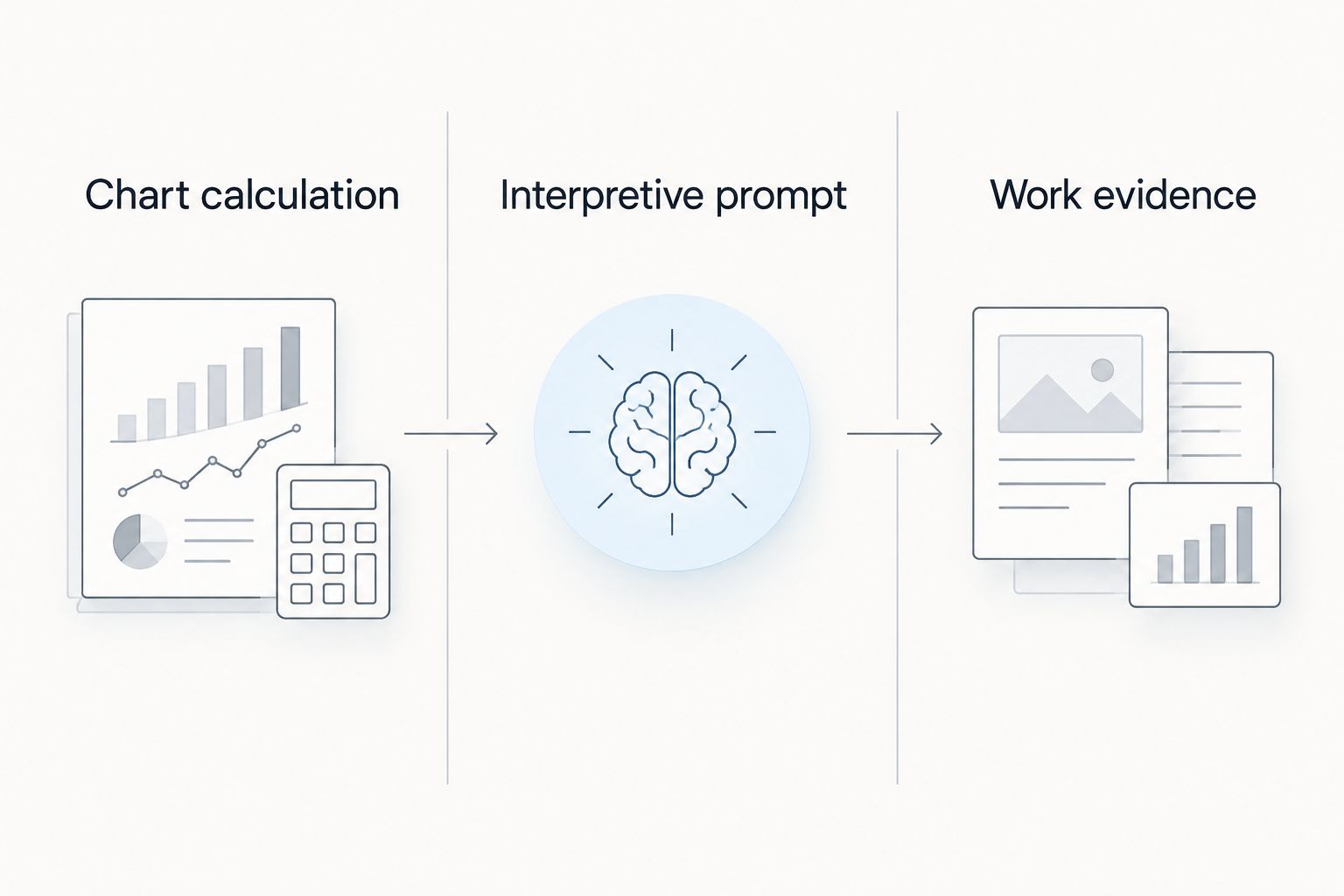
Keep 3 columns on paper: chart calculation, interpretive prompt, and work evidence. A prompt about responsibility is not proof that a charge role suits you. Compare it with what you learned when you handled a difficult handoff or trained a colleague. The first Astrofluence read is free with no card if you want to put the layers together after checking them yourself.
- Copy each calculated placement without adding a job recommendation to it.
- Turn each interpretation into a question you can answer from experience.
- Add an example from a recent shift or a role you have observed.
- Cross out any conclusion that depends only on the chart.
Compare work rhythm with your actual schedule
The 6th house offers a prompt about daily work. Your schedule shows what that work asks of you. Put them beside each other. If the prompt raises questions about routine, look at the routines you control and the ones your unit sets. Do not use a reading to explain away missed breaks, a workload concern, or a schedule you need to discuss.
Make a short shift log for the week. You are not trying to prove that a placement caused a hard Tuesday. You are looking for a question worth raising with the person who can change your schedule or responsibilities. That distinction matters when you are tired and tempted to make a permanent decision after one difficult shift.
- Note your assigned shifts and any swaps you request.
- Write down the task or handoff that made each shift harder or easier.
- Separate a schedule problem from a problem with the role itself.
- Bring one specific request to a schedule conversation in 2026.
Check the money and role terms in writing
A reading can prompt you to think about your money pattern. It cannot evaluate an offer for you. If you are weighing a different unit, contract, or training path, put the actual terms on one page before deciding. Compare the responsibilities as closely as you compare the pay information you have.
The same rule applies to a role that sounds more meaningful. A teaching or leadership prompt from a chart does not establish that a charge position fits your week. Ask what duties change, what support exists, and what happens to your schedule. If an answer is missing, get it from the workplace rather than filling it in with an interpretation.
- Collect the written terms for each option you are comparing.
- Note the expected schedule and responsibilities for each role.
- Ask how a change affects your existing commitments.
- Identify the unanswered question that could change your decision.
Run one small test before Friday
You do not need to settle your entire career to test a chart prompt. If you are considering education, ask about an opportunity to explain a process to a colleague. If you are thinking about a new specialty, speak to someone who works there. If launch timing is on your mind because you plan to offer a service, draft the offer and check its practical requirements before you publish it.
Choose a test with an observable result. By Friday, you should know more about the work, not just more about how the interpretation feels. Keep the test within your current role and workplace rules. A reflective tool does not replace clinical judgment or permission to take on a new duty.
- Choose one question raised by the reading.
- Pick one conversation, request, or draft that tests it.
- Set a Friday deadline you can meet this week.
- Record what you learned and what remains unknown.
Decide the next move from the evidence
At the end of the week, read your notes without trying to make the chart right. You can find a prompt useful and still decide against the role it made you consider. You can also discover that the immediate fix is a schedule conversation, not a career pivot. Both are decisions.
Write your next move as a sentence you can act on: request a meeting, review the written offer, or gather information about the specialty. If the evidence is thin, the next move is to collect more of it. Keep that separate from a prediction that a change will work out.
- State what the test showed and what it did not show.
- Choose one action tied to a real person or document.
- Keep clinical, financial, and workplace decisions grounded in qualified advice.
- Revisit the larger question after you have the missing information.
Options for nurses in 2026
Astrofluence career guidance is best for nurses who want a structured reflection on a real work decision; it does not determine specialty fit or predict a promotion. A notebook gives you more control over the questions. A conversation with a colleague gives you direct information about a role. Use the option that answers the question you actually have.
| Option | Best for | Access | Key limitation |
|---|---|---|---|
| Self-directed chart and work notes | Checking a prompt against your own shift evidence | Do it yourself | You must keep the calculation and interpretation separate |
| Astrofluence first read | Bringing chart and numerology layers into one career question | First read is free with no card | A reflection, not an assessment of your workplace |
| Workspace | Revisiting direction, work rhythm, money, and timing questions | Review current terms before starting | Cannot verify an offer or make a decision for you |
| Conversation with someone in the target role | Learning what the work involves | Arrange the conversation directly | One person's experience does not describe every workplace |
The table separates tools from evidence. A chart read can help you frame a question. The person doing the job can tell you about their duties. Written terms tell you what you are being asked to accept. None of those sources should quietly stand in for the others.
Common mistakes nurses make
- Treating the Midheaven as a job assignment. It is a point for reflecting on public direction, not a list of specialties. Ask what kind of responsibility you want before attaching a job title to it.
- Using the 6th house to excuse a difficult routine. A placement cannot tell you whether a workload is acceptable. Describe the routine, then raise the practical issue with the right person.
- Letting a Life Path number settle a contract decision. Numerology supplies an interpretive prompt. The written terms, your obligations, and professional advice decide what needs checking next.
- Reading a hard Monday as proof that you need to leave. Write down what happened and test the smallest change available first. A schedule request and a career change are not the same move.
- Guessing a birth time and trusting the houses. If the recorded time is unavailable, label the chart detail as uncertain. Do not build a 2026 career decision around a placement you cannot confirm.
FAQ
What is astrology career guidance for nurses?
It is a reflective way to compare birth-chart and numerology prompts with real nursing work decisions. It does not measure clinical skill or predict which specialty will suit you.
Which chart parts are useful for a nursing career question?
The Midheaven addresses public direction, while the 6th house addresses daily work and routines. Compare either prompt with your own schedule, duties, and experience.
Can a birth chart tell me to leave bedside nursing?
No. A chart cannot make that decision or assess your working conditions. Use the question it raises to identify a conversation or practical test before you choose.
Does my Life Path number identify the right nursing specialty?
No. A Life Path number is a numerology calculation you can use as a reflection prompt. Compare any interpretation with the actual duties and terms of the specialty.
Do I need an exact birth time for a career reading?
You need an exact birth time for a reliable reading of time-dependent chart points and houses. If you do not have one, identify that limit rather than treating those placements as certain.
How much does an Astrofluence career reading cost?
The first read is free with no card. Workspace has a 3-day trial; check the current terms on the site before you start.
Can astrology predict the best time to change nursing jobs in 2026?
No. Timing is a subject for reflection, not a prediction that a change will succeed. Check application deadlines, written terms, and your own commitments before setting a date.
One last thing
A useful result does not have to be a new career plan. If your 2026 reading raises a question about daily work, the best Friday test is often a specific schedule conversation. Bring one example from your week and one request. If that conversation changes what you know, you have made progress without asking a chart to make the decision for you.