
MBTI describes the preferences you report in a questionnaire. Astrology reads a birth chart as symbols for reflection. Neither can choose a job for you. If you are considering a career change, the useful question is what each helps you notice and what you can test at work. This comparison explains their different inputs, shows how Astrofluence uses chart patterns, and keeps a hypothetical example separate from evidence. We make Astrofluence, so this is our perspective, not an independent product test.
Quick verdict
- MBTI. Groups reported preferences into a four-letter type. Useful for: naming how you prefer to work and discussing those preferences.
- Astrology. Uses birth-chart symbols as prompts. Useful for: exploring a work question from a different angle.
These methods are not equivalent measures. MBTI is a personality questionnaire; a chart interpretation is symbolic. Neither result demonstrates job skills. The next step is to compare a useful question with your own experience.
Takeaway: choose a question worth testing, not a label that sounds certain.
How Astrofluence builds a career read
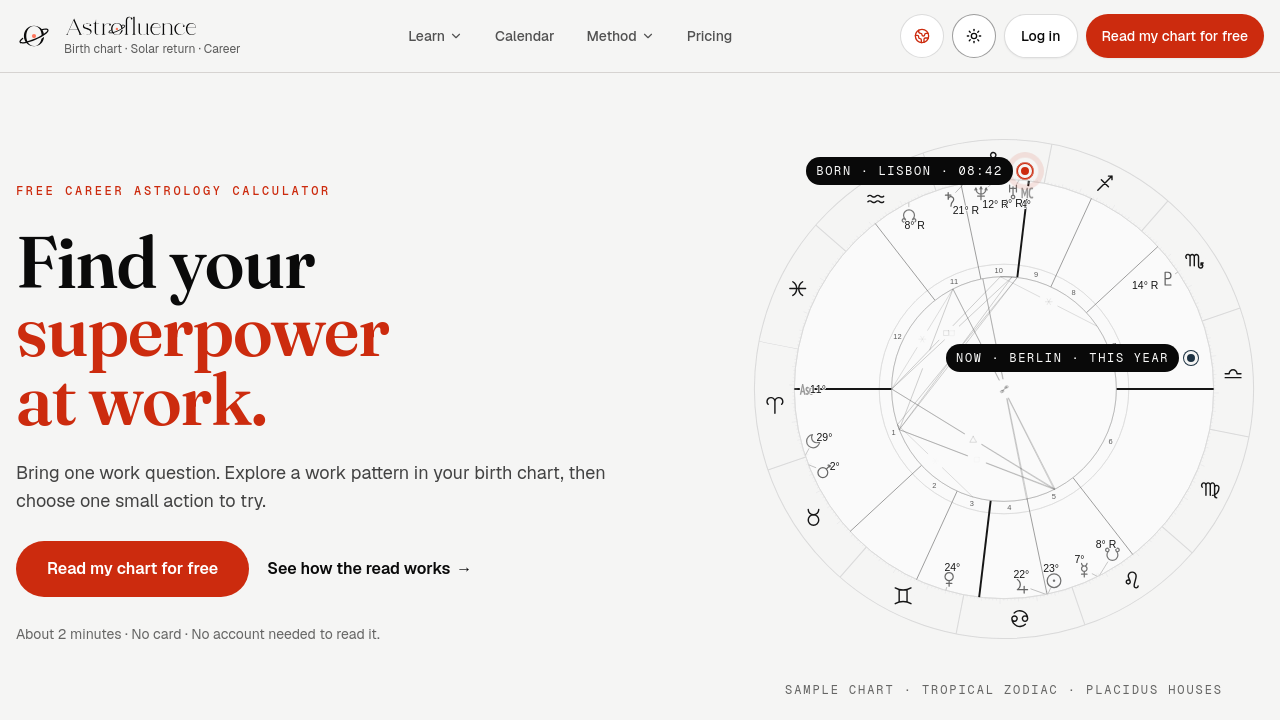
Astrofluence starts with birth details and your work question rather than a personality questionnaire. The chart calculation uses the birth data; the read connects those symbols to your question. The same birth data supports a repeatable calculation, but your question and situation still matter to the interpretation. Fixed inputs do not make a career claim true.
What goes in
The chart and question inputs are:
- Your birth date
- Your birth time, if known
- Your birth place
- The work question you want to explore
The start form also asks for your email to open the read with an access code. That code is not a workspace account. If your birth time is unknown, choose that option rather than guessing. Time-dependent details such as houses and the Midheaven are limited; birth-date numerology remains available. Astrofluence uses the tropical zodiac and Placidus houses when the data supports them.
What comes out
The read connects your question with work patterns around direction, rhythm, money and timing, and offers a practical next action. It is a reflection prompt, not a prediction of a job offer or pay rise.
The Career Archetype system has twelve patterns. It uses fixed scoring rules for chart factors, rather than a personality quiz. A result may be provisional or unavailable when the chart does not give enough support. The pattern is not an identity or proof of ability. It can help you explore your superpower: a useful work pattern to try, not a talent the chart has proved.
Takeaway: a repeatable calculation and a useful interpretation are different things. You can question both the fit and the suggested action.
At a glance: astrology vs MBTI
| Feature | Astrofluence chart read | MBTI | What to compare |
|---|---|---|---|
| Input | Birth details and a work question | Answers to a questionnaire | Which information you want to explore |
| Method | Chart calculation, then symbolic interpretation | Reported personality preferences | Neither measures job performance |
| Free access | Free read, no payment card | Check the chosen assessment's terms | Free online quizzes are not all official MBTI |
| Getting started | Birth details; unknown time is supported | No birth details needed | Available information and purpose |
| Who it is for | Someone exploring a specific work question | Someone exploring personality preferences | The question you need help framing |
| Using it afterward | Optional workspace with a plan and action tracking | Discussion or exercises, depending on the service | These are uses, not software integrations |
| Support | Career chat in the subscriber workspace | Depends on the provider or practitioner | Actual access and support terms |
Takeaway: this table compares inputs and uses. It does not rank accuracy or declare a winner.
What each one measures

MBTI: stated preferences
MBTI groups preferences about attention, information, decisions and structure. The Myers & Briggs Foundation distinguishes those preferences from skills and abilities. A preference for planning, for example, does not establish that you manage projects well. The official assessment and unrelated four-letter online quizzes should not be treated as the same product.
Astrology: symbolic birth-chart patterns
A birth chart maps celestial positions for a birth time and place. Two terms often appear in career readings:
- Midheaven. A chart angle linked in astrology to public direction and reputation. Its position depends on birth time and place.
- Houses. Twelve chart areas used for themes such as daily work, money and reputation.
These symbols do not measure your performance, your skills or the demand for your work. To assess those, look at completed tasks, feedback and the requirements of real roles.
Takeaway: keep the suggested pattern separate from what you have observed at work.
Using both together: a hypothetical example

Fictional example: Dana is a project coordinator considering a change. Her MBTI result describes a preference for planning and closure. Her chart read raises a question about visibility: could she try sharing an idea of her own, alongside keeping a project on track? This is an example of a question, not a finding about a real person.
The two results could give Dana two questions:
- From MBTI: Does advance planning help my work, or do I simply find it more comfortable?
- From the chart: What could I learn by presenting one idea, rather than only a status update?
She could try two small experiments over two weeks. For similar tasks, she compares a detailed plan with a lighter one and records what helped or got in the way. She could also present a short proposal and ask for specific feedback on its clarity. Different deadlines or workloads would affect the comparison, so this would be a practical check, not a controlled study.
No outcome is assumed. Dana might keep an approach, change it or decide that a prompt does not fit. Her observations guide the next choice.
Takeaway: make the question small enough to try, then set a date to look at what happened.
Where MBTI may be useful
MBTI may suit these situations:
- A shared vocabulary. If your team already uses it, type language can help start a conversation. Ask what the terms mean to each person.
- No birth details. MBTI does not need them. A chart read can accept an unknown birth time, but some details stay unavailable.
- A practical work discussion. Saying you prefer a written plan may be more useful than naming any type. A label should not become a rule about what a colleague can do.
Takeaway: for teamwork, describe the preference and ask what would help. A type code is optional.
Who should pick which

- A work question feels hard to frame. A chart read can offer a prompt about where to try a useful pattern. Check whether it fits your actual situation.
- You want to explain a work preference. MBTI may help you name it. Pair the description with a concrete request, such as written priorities.
- You are considering a move or a pay discussion. Either can prompt questions, but compare role details, workload, pay and your own constraints before deciding. Astrofluence does not make that choice for you.
Takeaway: start with the decision, then use the method that helps you ask a clearer question.
FAQ: Frequently asked questions
Is astrology more accurate than MBTI for career choice?
There is no basis here for an accuracy ranking. MBTI describes reported preferences; astrology offers symbolic interpretations. Neither result establishes that a job suits your skills. Work samples, experience and feedback answer different, essential questions.
Does Astrofluence say astrology is scientifically proven?
No. Astrofluence separates calculated chart positions from their symbolic meaning. The interpretation can suggest something to reflect on, but it is not scientific evidence of ability or future work outcomes.
Can I use both for career decisions?
Yes, as prompts. You could take one question from each, try a small relevant task and compare what happened with what you expected. You still weigh practical needs and make the decision.
What do I need for a free career read?
Your birth date and place, your birth time if known, and a work question. The form also asks for an email address so you can open the read with an access code. Workspace sign-in is a separate step.
What if I do not know my birth time?
You can choose unknown time. Time-dependent details, including houses and the Midheaven, are limited rather than presented as known facts. Birth-date numerology can still be calculated. A Career Archetype result may be provisional or unavailable.
How much does Astrofluence cost?
The read is free. The workspace subscription is listed at US$12.90 a month or US$129 a year. Trial eligibility is separate: a first subscription may qualify, while a restart is billed from day one. Check current pricing and the checkout terms for the offer available to you. Subscriber tools include a plan, action tracking and career chat; opening a free read does not start a paid subscription.
Does Astrofluence pick a job for me?
No. It offers a work pattern and a next action to consider. You decide whether that action helps, and you choose jobs using your skills, needs, options and experience.
Is the Career Archetype a quiz result?
No. It uses fixed rules to score chart factors across twelve patterns. It is separate from a personality questionnaire and may be provisional or unavailable. A repeatable pattern is still a reflection prompt, not a measure of talent.
Conclusion
MBTI can help name a preference. A birth chart can offer a different question. Neither needs to become a label you must live up to. The useful part is what you can try and learn in a real work situation, whether that is a job, freelance project or business idea.
If you have a work question in mind, Read my chart for free. Astrofluence connects your birth details with that question and offers a next action to consider. Bring the result back to the decision you are facing, and choose what to test.