
In astrology, the career axis links the Midheaven (MC) with the opposite point, the Imum Coeli (IC). It can help you ask where a useful work pattern belongs: in a visible role, or in the quieter work that supports it. It is a symbolic prompt for weighing public work against private foundations, not proof of which path will succeed. That distinction matters most when you have two real options in front of you and keep circling. The axis will not choose for you. It can sharpen the questions you ask before you do.
What the career axis means in astrology
The Midheaven is an angle near the top of a birth chart. In Placidus and other quadrant house systems, it marks the start of the 10th house, traditionally linked to career and public life. As the astrology journal Holisticism notes, the 10th house is linked to career, and planets at or near the MC are worth a close look. Directly opposite sits the IC, the base of the 4th house, associated with home, roots and what supports you privately.
Systems differ. We use the tropical zodiac and Placidus houses, which is one common way to calculate where those house lines fall.
In plain language: the MC asks what you want to be seen doing; the IC asks what has to be steady underneath for that to last.
Takeaway: when two paths compete, treat them as two answers to those paired questions, not as a test you pass or fail.
How the career axis works: a hypothetical two-path example
You need an accurate birth time to locate the MC and the houses. You can mark your time as unknown, but houses or an MC calculated from an assumed time must not be treated as your actual placements. Birth-date numerology can still be calculated.
Hypothetical example: Someone is choosing between a visible team-lead role with presentations and stakeholder meetings, and a steadier specialist role working mostly behind the scenes. Both pay similarly. They have a birth date, time and place, plus one question: which role fits how I want to work for the next stretch?
Step 1: find your Midheaven
Locate the MC sign and any planets near it. In the hypothetical, the MC in this example reads symbolically as a pull toward being a recognizable voice. That becomes a question, not a verdict: "Do I want to be known for leading people, or for the quality of my work?"
Step 2: read the opposite end, the IC
Now look at the IC. Suppose the IC in this example reads as a strong need for predictable routines and protected evenings. The second question: "What does each role demand from my home life and energy?" The visible role might satisfy the MC theme while straining the IC theme. The quieter role might do the reverse.
Step 3: test the symbols against real work evidence
This is where symbol stops and evidence starts. They list plain facts for each role:
- Hours, travel and after-hours expectations, confirmed with the hiring manager.
- Past weeks they felt energized versus drained, from a calendar review.
- Feedback from people who have done each job.
If the evidence contradicts the chart reading, the evidence wins for the decision. The chart only helped frame what to check.
Takeaway: write your MC question and IC question on one page, then fill a second page with facts that could prove either reading wrong.
Why it matters when you are stuck between two paths
Being stuck often means you are weighing two things at once without naming them. The axis separates them.
Use 1: clarifying what you want to be known for
The MC end prompts a concrete sentence: "In two years I want colleagues to come to me for ___." If one path makes that sentence true and the other does not, you have learned something about yourself, whatever your chart says.
Use 2: checking what stability you need underneath
The IC end asks about the foundation. Commute, schedule, family load and recovery time are not side issues. A role that looks right on paper can fail here first.
Use 3: turning a read into one small test
A useful reflection ends in something you can try. Astrofluence’s free read uses your birth details and work question to suggest a work pattern and a next action. For two possible roles, ask what each would let you contribute and what support you would need. You still choose the role. Read my chart for free to explore that question, then compare the reading with what each job actually involves.
Takeaway: whatever tool you use, end every reflection with a dated experiment you can review.
Common misconceptions about career astrology
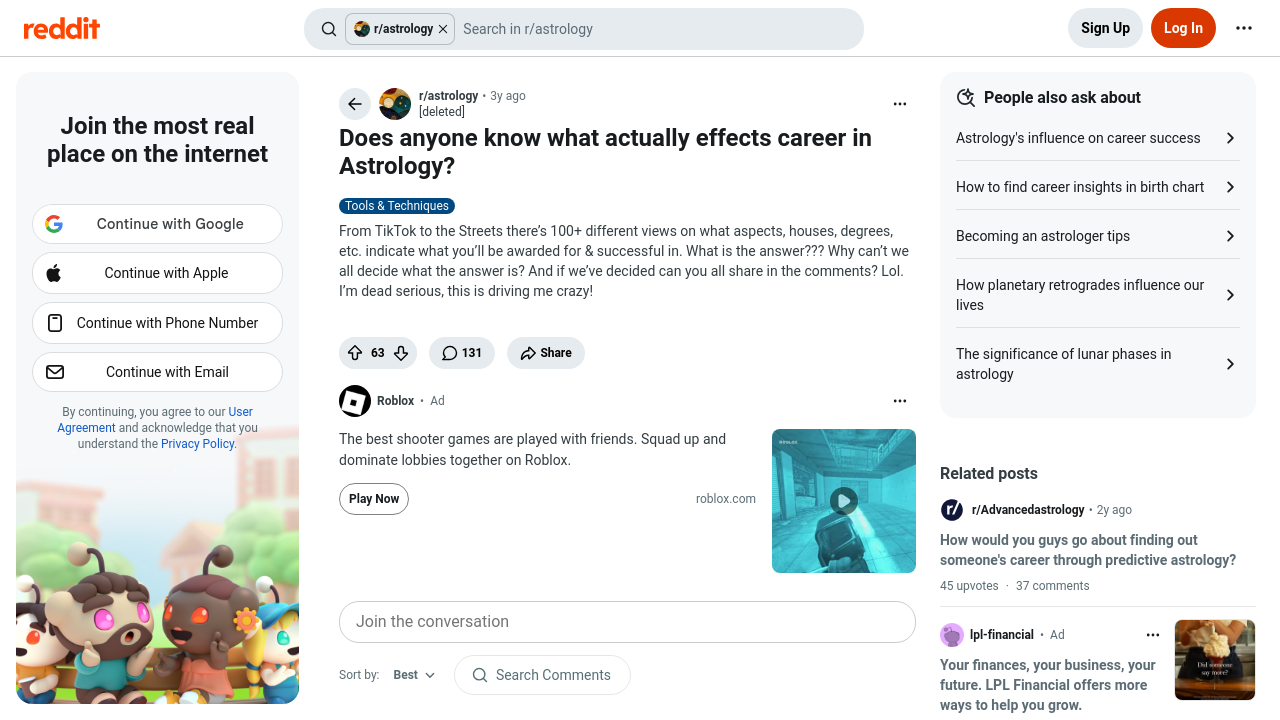
Opinions vary widely. One Reddit thread discusses different views on aspects, houses and career. A discussion is not evidence that any placement predicts an outcome.
Misconception: the 10th house decides your job
Reality: it is one symbolic signal among many. Even astrologers who emphasize the 10th house point to the 4th house and other factors.
Misconception: sign and house lists predict success
Reality: popular observation lists are usually anecdotal. Some say so openly, describing themselves as personal observation from reading charts. Treat them as conversation starters, not data about work.
Misconception: planets like Saturn delay jobs
Reality: a chart cannot forecast when an offer arrives. If Saturn themes resonate, read them as a prompt about structure, patience or skill-building, then check the actual hiring timeline with employers.
Misconception: astrology is proven
Reality: it is not scientifically proven. Its value here is reflective: structured questions you might not otherwise ask.
Takeaway: use readings to generate questions and let work evidence answer them.
Related concepts
Midheaven (MC)
An angle near the top of the chart, at the 10th-house cusp in Placidus. Career question: what kind of public role or reputation draws you?
Imum Coeli (IC)
The point opposite the MC, at the 4th-house cusp in Placidus. Career question: what private foundation does your work need?
10th house
The sector traditionally linked to career and public standing. Career question: where do you want visible responsibility?
6th house
Traditionally linked to daily work and routines. Career question: what does a sustainable ordinary Tuesday look like for you?
Career Archetype
Astrofluence uses calculated chart signals for its Career Archetype, a reflective pattern rather than proof of ability. It may be unavailable when the birth time or chart evidence is missing. Career question: which working style does this pattern describe, and does it match your track record?
Solar return
The chart cast for the moment the Sun returns to its birth position each year. Astrofluence uses solar-return and birth-chart information in its reflective read. These themes do not set your prices or predict results. Career question: what do you want this coming year of work to focus on?
How to get started

- Gather your birth date, time and place. Check a birth certificate if you can; the time drives the MC.
- Write both paths and one question. Keep it to a single sentence you could answer yes or no.
- List real-world evidence for each path. Hours, skills used, people you would work with, what you have enjoyed before.
- Run a chart read. Compare its framing with your evidence and note where they disagree.
Takeaway: the disagreements are often the most useful part.
FAQ: Frequently Asked Questions
What planet in astrology rules career?
No single planet does. Astrologers usually start with the 10th house, the Midheaven, its sign's ruling planet and any planets near the MC. Treat all of these as symbolic prompts for questions about your work, not answers.
Which planet delays a job?
No planet can delay or schedule a job offer. Some astrologers associate Saturn with slowness and structure. Use that, if at all, as a prompt to review skills or process, and rely on employers for timelines.
Which line in astrocartography is for career?
Astrocartography maps chart angles onto locations, and MC lines are commonly associated with career themes. Treat them as reflective symbols, and weigh real factors like job markets, cost of living and support networks before moving anywhere.
What can a yearly horoscope say about career?
A general yearly horoscope cannot describe your career, and no chart forecasts outcomes. A more useful approach is setting a clear work question, then reviewing real progress against it at set dates.
What if I do not know my birth time?
Without a birth time, the Midheaven and houses cannot be calculated reliably. You can mark the time as unknown. Houses or an MC calculated from an assumed time are not reliable personal placements; birth-date numerology still works. Try a birth certificate or hospital record to find the time.
Can a chart tell me which job to take?
No. A chart can frame questions about visibility, stability and work rhythm, but it does not choose jobs for you. The decision rests on your evidence, your priorities and the conversations you have.
Conclusion
The career axis is a prompt, not a verdict. The MC asks what you want to be seen doing; the IC asks what must hold steady underneath. Your work evidence decides between them.
This week, try one test: ask someone in each of your two target roles to describe a typical week, then mark which description fits your IC needs better. Revisit your answer in seven days.