
Ask a natal chart a narrow question about how you work (direction, rhythm, money, timing) rather than what job you should have, then test the symbolic answer against evidence from your actual work. A chart cannot prove a career outcome, so the decision stays with you. This guide takes about 15 minutes to set up and two weeks to test, and it suits beginners. You do not need to know astrology already; the few terms that matter are explained as you go.
What you'll need

- Your birth date, time and place. The time matters for houses and the Midheaven, covered below.
- One career question you keep carrying. The one that comes back on Sunday nights, not a list of ten.
- A notes file. A phone note or spreadsheet works. You will log a few things daily.
- 15 minutes for setup, plus a minute or two a day for two weeks.
- A chart source. Choose a calculator that explains its inputs and limits. Astrofluence asks about your birth details and work situation.
Takeaway: if you cannot write your question in one sentence yet, start there before opening any chart.
Before you start
Decide now what counts as a symbol and what counts as evidence. A symbol is what a placement suggests; evidence is something you can observe in your work, like which tasks you finish early, which ones drain you, and what people ask you for. Keep those in separate columns from day one.
Check your birth time. If it is unknown, skip houses and the Midheaven entirely, because both depend on the exact time. With an unknown birth time, Astrofluence labels its read as an approximate noon chart. Its houses and Midheaven are not confirmed birth placements, and it does not assign a Career Archetype. Birth-date numerology can still be calculated. Finally, accept the ground rule: the chart prompts the question, your evidence informs the answer, and you make the call.
Step-by-step: turn your chart into better career questions

Step 1: Write down the question you keep carrying
Write the question exactly as it sounds in your head, even if it is messy: "Should I leave my job?" or "Why do I hate Mondays?" Do not clean it up yet.
Check: you have one sentence written down, ending in a question mark.
Step 2: Learn the three chart terms that matter for work
You only need three terms to start:
- Sun sign: the zodiac sign the Sun was in when you were born. Read it as a prompt about what kind of effort feels like yours. Useful question: what work leaves me with more energy than it took?
- Houses: twelve slices of the chart, each tied to an area of life, calculated from your birth time and place. Astrofluence uses the tropical zodiac and Placidus houses, two common technical choices. Useful question: which area of work does this placement point me to look at?
- Midheaven (MC): a chart angle calculated from your birth time and place. In beginner chart discussions, such as this r/beginnerastrology thread, the Midheaven is described as marking public image and long-term achievement. Useful question: how do I want to be seen at work?
Check: you can write one plain-English sentence for each term without looking it up.
Step 3: Rewrite vague questions into testable ones
A vague question invites a vague answer that feels true no matter what. A testable question names a behavior you can observe. Use career astrology to form questions about yourself, then check them against how you spend your working time.
Hypothetical example: the table below rewrites three vague questions. The numbers are example assumptions: a 2-week log, 3 tasks tracked, 1 review date.
| Vague question | Testable rewrite | Symbolic prompt | Evidence check |
|---|---|---|---|
| What career should I have? | Do I want more visible work than I have now? | Midheaven as public image | Log 3 tasks for 2 weeks; mark which ones involved being seen and how you felt after |
| Why am I so tired at work? | Do I do my best work in long focus blocks or short bursts? | A placement read as work rhythm | Note start, stop and energy level for 3 recurring tasks across 2 weeks |
| Am I underpaid? | Do I avoid naming my price, and how does my pay compare with similar roles? | A placement read as how you price | Note pricing conversations for 2 weeks and compare reliable pay ranges for similar roles, locations and experience |
Check: your rewritten question names something you can observe. A short log cannot settle every pay or career question.
Step 4: Separate the symbolic reading from workplace evidence
Open your notes file and make two columns: "Chart suggests" and "Work shows." Put the reading in the first column as a hypothesis, never as a fact about you. The second column only takes things you observed: hours, tasks, feedback, offers, outcomes.
Check: nothing in the "Work shows" column starts with "I feel like I'm the type who..."
Step 5: Ask about direction, rhythm, money and timing, one at a time
Four lenses keep career questions narrow:
- Direction: what kind of work you are moving toward.
- Rhythm: how you naturally pace and deliver work.
- Money: how you price and ask.
- Timing: when you tend to start, finish or switch, read as a pattern to notice, not a date to act on.
Pick one lens for this round and rewrite your question from Step 3 so it fits that lens alone. Mixing lenses produces a question too broad to test.
Check: your rewritten question touches exactly one lens.
Step 6: Run a two-week check against your real work
Track your chosen tasks every working day for two weeks. Keep entries short: task, time spent, energy before and after on a 1 to 5 scale, one line of notes. Try recording your observations before rereading the chart, so you leave room for details that do not fit the reading.
Check: you have about ten working days of entries with no gaps longer than two days.
Step 7: Set a review date and decide for yourself
Put a review date on your calendar for the day after the log ends. On that day, compare the two columns. Where they agree, you have a pattern worth checking again, not proof that the chart caused or predicted it. Where they disagree, trust the work column and write down what you will try next.
Check: you have a calendar entry and one written next move, chosen by you.
Takeaway: the chart earned its place if it made you ask a sharper question, whether or not the evidence agreed with it.
Where a free chart read fits

If you would rather not interpret placements yourself, a free read can do the first pass. The Astrofluence free read connects your current role, desired direction and the pressure you name with chart-based questions about work. It offers a small next step you can assess yourself. With a known birth time, it can also show a Career Archetype calculated from chart signals, rather than a personality quiz. Unknown-time reads use a labelled approximate noon chart and leave the archetype out.
Treat the output as Step 3 material: a prompt to rewrite and test. Read my chart for free to connect this exercise with your own work question.
Takeaway: use the next move it gives as the first entry in your two-week log.
Troubleshooting
Symptom: every answer feels true for you
Cause: the question is too broad, so any reading fits. That skepticism is fair; vague statements feel personal to almost everyone.
Fix: go back to Step 3 and add something countable: a task, a number of conversations, a time of day.
Symptom: the chart seems to say one thing, your work another
Cause: the symbol was treated as a conclusion instead of a hypothesis.
Fix: let the work column win. Then ask whether the reading pointed to something you want but have not tried, and test that as a separate question.
Symptom: you want a yes or no on a job change
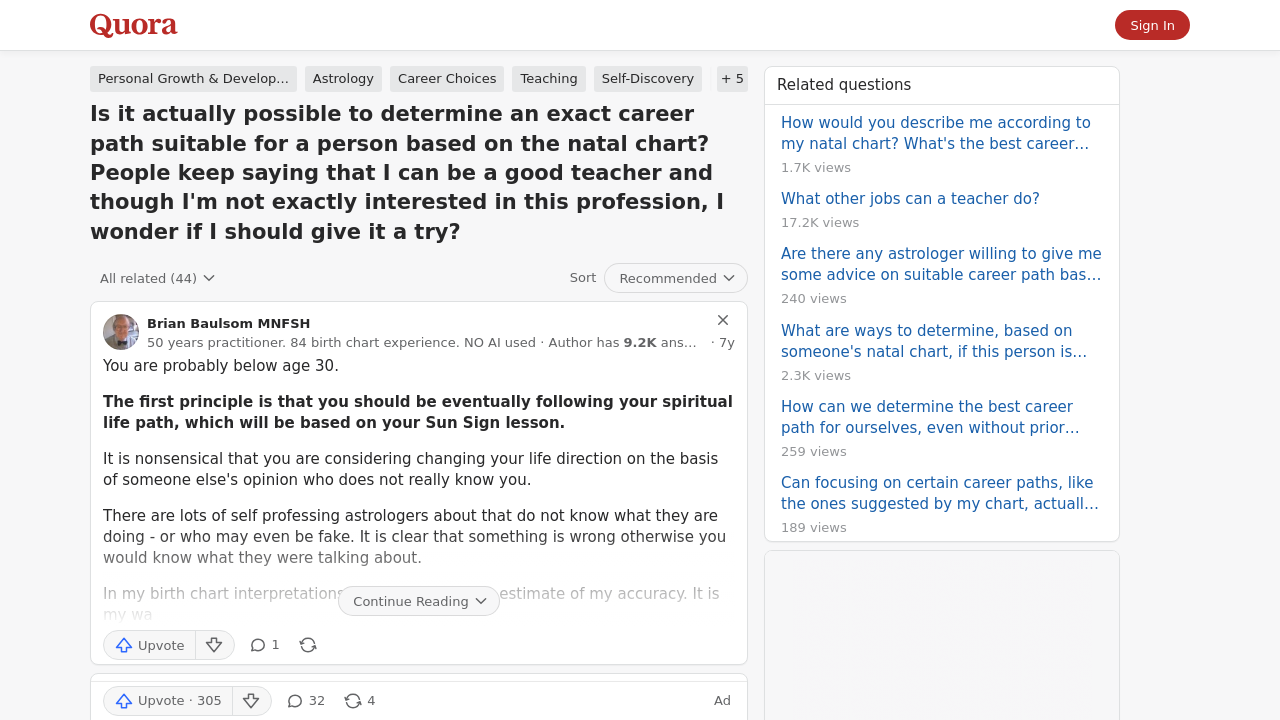
Cause: you are asking the chart to make the decision. People on Quora openly question whether a chart can give an exact career path, and that doubt is reasonable.
Fix: break the decision into smaller questions about rhythm, visibility or pay, test each one, and weigh the results yourself. Astrofluence does not choose jobs or financial moves for you.
FAQ: Frequently Asked Questions
What career should I have based on my birth chart?
A chart cannot name the right job. It can suggest themes, like how visible you want to be or how you pace work, which you then check against real tasks before deciding anything yourself.
Can I predict my career based on my birth chart?
No. A chart is a reflective lens, not a forecast. Use it to frame questions about your work patterns, then let evidence from your actual working weeks shape what you decide to try next.
What is the Midheaven and why does it come up in career questions?
The Midheaven is a chart angle calculated from your birth time and place. Chart discussions commonly treat it as a pointer to public image and long-term achievement, so it prompts questions about visibility and reputation at work.
Do I need my birth time?
For houses and the Midheaven, yes, because both depend on the exact time. Without it, Astrofluence uses a clearly labelled approximate noon chart. Its houses and Midheaven are not confirmed birth placements, and no Career Archetype is assigned. Birth-date numerology remains available.
Is astrology scientifically proven?
Astrology has not been established as a way to predict career outcomes. Astrofluence separates chart calculations from their symbolic meaning. That is why every reading here gets tested against observable evidence from your work.
What does the Astrofluence free read cover?
It connects your work situation and desired direction with chart-based reflection and a small next step. Known-time reads can include a Career Archetype. You choose what to try and when to review it.
Conclusion
A better career question is narrow, names one lens, and can be answered by your own log. The chart supplies the prompt; your work supplies the evidence; you supply the decision. Your testable action for this week: write down one question, log two weeks of evidence against it, and set a review date on your calendar. For a starting prompt tied to your own work situation, Read my chart for free. Choose a next step from the read and set your own review date.