
After a layoff, check your paperwork and deadlines, confirm pay and benefits in writing, and ask your local agency about income support. Then review expenses and plan your search. Once urgent matters are covered, you can ask which parts of your last role you want to keep. This guide uses US benefit examples, including COBRA and state unemployment insurance. Elsewhere, use your local official guidance. Work through these steps over your first two weeks, at a pace your situation allows.
What you'll need
- Your layoff paperwork: the notice, any separation or severance agreement, and benefits letters.
- Your last few pay stubs, so you can check final pay against what you normally earn.
- A summary of your current benefits, including health insurance and retirement accounts.
- A simple budget spreadsheet or notebook.
- Your resume, even if it is out of date.
- A contact list of recent coworkers, managers and people who could vouch for your work.
- A few hours across the first week, in short blocks rather than one marathon.
Before you start

Read separation and severance documents before agreeing, and check the actual response deadline. Ask for more time if you need it; do not assume an extension is guaranteed. The US Department of Labor’s termination guidance explains that relevant rules vary. Ask a qualified local adviser about terms you do not understand, especially any waiver of rights. Keep a copy of the documents and your questions.
Step-by-step: your first two weeks after a layoff
Here is the checklist to work from.
| Action | Why it matters | What to confirm |
|---|---|---|
| Exit paperwork | Signing may waive options | Deadline to sign; whether you can get more time |
| Severance | It affects the money available during your search | Whether you receive it, how long it lasts, how it is paid |
| Final paycheck and unused vacation | You need a clear record of amounts and dates | Payment date; whether unused vacation is paid out |
| Health insurance (COBRA or marketplace) | You need to know when any replacement cover starts | The date coverage ends; COBRA versus marketplace options |
| Unemployment filing | Your agency sets filing and eligibility rules | Your state's filing process and what it asks for |
| Expense triage | Stretches your cash | Which bills and subscriptions can pause or end |
| State and local help | Fills gaps benefits miss | Local eligibility rules, application steps and contact details |
Step 1: Pause and name what happened
Write one factual sentence about what happened, using the reason your employer gave rather than guessing. A role ending does not describe every skill you have. Give yourself room to process the news. Outcome: a clear account you can use when asking for help. Check: the sentence sticks to facts you can confirm.
Step 2: Get severance, final pay and benefits in writing
Email HR asking for written details on severance, your final paycheck date, unused vacation payout and the date health coverage ends. Outcome: one document with every answer. Check: each row of the table above has a written answer, not a verbal one.
Step 3: File for unemployment
In the US, check your state unemployment agency’s instructions promptly. Eligibility and how severance affects a claim depend on state rules. Submit the information the agency asks for and follow its instructions. Outside the US, use the relevant public benefits service. Outcome: a claim or a clear record of your next required step. Check: save any confirmation and deadline.
Step 4: Secure health coverage
If you lose US job-based health coverage, compare the options actually available to you. HealthCare.gov explains COBRA and Marketplace options, including enrollment timing. Do not cancel existing coverage before checking when replacement cover can begin. Outcome: a chosen option and confirmed start date. Check: compare the last covered day and the new start date; ask the insurer about any gap.
Step 5: Triage your expenses
List every recurring cost, then mark each as essential, reducible or cancelable. Cancel subscriptions you will not miss. Outcome: a leaner monthly number. Check: your budget shows how many months your cash and expected income cover.
Step 6: Find local help and benefits
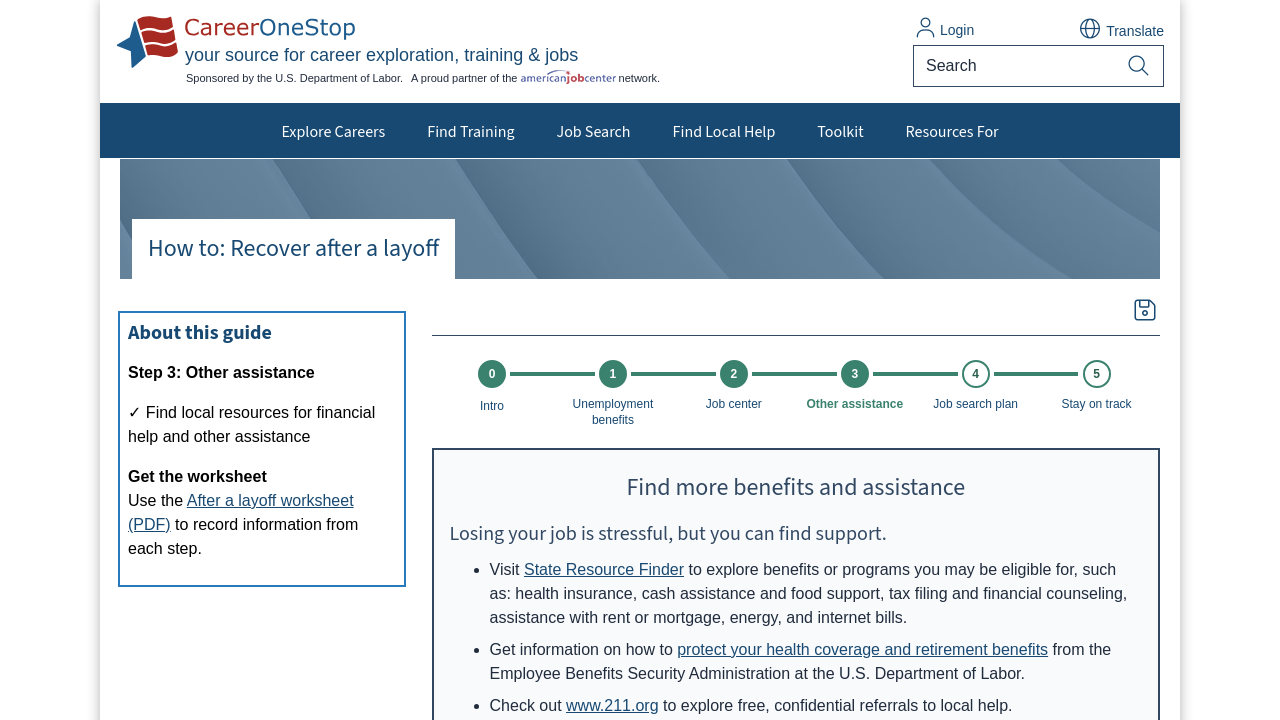
For US support, search the State Resource Finder on CareerOneStop and visit 211.org for local referrals. CareerOneStop lists help with health insurance, food support, financial counseling, and rent, mortgage, energy and internet bills. Outcome: a short list of programs that fit you. Check: you have checked eligibility and contacted a relevant service about next steps.
Step 7: Update your resume and tell your network
Refresh your resume, ask a former manager for a reference, and tell relevant contacts what you are looking for. Search length varies; avoid building your plan around one promised timeline. Outcome: a current resume and a few useful conversations. Check: three people know what kind of role you want.
Step 8: Ask one career-direction question and test it
Only now ask the bigger question: return to the same kind of role, or shift? Write it as one sentence you could test. Outcome: a clear question rather than a vague worry. Check: it fits on a sticky note.
Choosing your next direction without rushing
A layoff can feel like a forced crossroads. The pressure is to apply everywhere at once. Choose a few realistic targets so you can explain why each role fits, while allowing room for urgent income needs.
Questions to ask before applying
- Which tasks in your last role gave you energy, and which drained you?
- Do you work best in steady daily rhythm or in intense bursts?
- Do you want more visibility, or quieter work where the output speaks?
- What would you need to learn to move one step sideways?
Hypothetical example: an operations manager notices the best weeks were spent building a new process, not running the old one. That points to process design roles worth testing.
Where a chart read fits
Some people use a birth chart as a reflective lens. A birth chart is a map of where the planets were at your birth date, time and place, and it is read symbolically, as prompts about how you lead, deliver and time your work. That is interpretation, not evidence about the job market. Your work history, references and conversations remain the evidence.
Astrofluence asks for your birth details and a question about work. If your birth time is unknown, say so; house and Midheaven conclusions need a reliable time. Use the reading to compare work patterns with your experience, not to decide benefits, money or job offers. Read my chart for free to explore which parts of your previous role you want to carry into the next one.
Troubleshooting

Symptom: Severance offer arrives with a short deadline
Possible issue: the response window leaves little review time. Next step: ask HR in writing about the deadline and whether more time is available. Keep the reply. Get qualified local advice if the agreement is unclear; an extension is not guaranteed.
Symptom: Unemployment claim is delayed
Possible issues include missing information, a mismatch in employer details or an agency backlog. Check your status and messages, then contact the agency. Correct information as instructed. Do not submit a duplicate claim unless the agency tells you to.
Symptom: Health coverage ends sooner than expected
Possible issue: the plan’s end date differs from what you expected. Confirm it with HR or the plan administrator. If you are in the US, check COBRA and Marketplace eligibility and enrollment dates promptly; elsewhere, contact the local coverage service.
Symptom: Applications go out but no replies
Possible issues include competition, hiring pauses or an unclear match between your resume and the role. You cannot infer the cause from silence alone. Review a few applications against the job requirements, improve relevant examples and ask contacts for feedback or introductions.
FAQ: Frequently Asked Questions
What to do as soon as you are laid off?
Check your paperwork and deadlines before agreeing to anything. Ask for written pay and benefit details. Then check the relevant public agency’s benefit rules and review essential expenses. This article’s COBRA and state unemployment examples are US-specific.
What is a typical severance package?
It varies widely by employer, role and tenure, and not every employer offers one. Ask HR whether you will receive severance, how long it lasts and how it is paid, and get the terms in writing.
What are you entitled to if you are laid off?
Rights depend on your country or state, contract and circumstances. Ask about final pay, unused leave, any severance, health coverage and benefit eligibility. Use official local guidance or a qualified adviser for your rights; an employer’s explanation is not independent legal advice.
What is the 3 month rule for jobs?
People use this informal phrase in different ways. It is not a fixed legal or job-search rule. Check your actual contract and deadlines rather than assuming a three-month period applies.
Should I sign the separation agreement right away?
Usually it is wiser to wait until you have reviewed it calmly. Ask for more time in writing if the deadline feels short, and consult a qualified professional if the terms are complicated.
Should I file for unemployment even if I have severance?
Check your state agency’s instructions promptly and disclose severance as required. State rules determine how it affects eligibility or payments. Follow the agency’s filing instructions rather than assuming severance automatically includes or excludes you.
What should I not do after getting laid off?
Avoid big, hard-to-reverse decisions in the first days, such as signing documents unread or making major purchases. Also avoid mass-applying to every opening before you know what you are targeting.
How long does a job search usually take?
There is no reliable timeline for an individual search. Role, location, experience, hiring conditions and available time all matter. Review your finances and search approach regularly instead of relying on an unsupported average.
Conclusion
The order matters: paperwork first, then income, then coverage, then direction. Handling the first three calmly gives you room to choose the fourth well, and if a reflective prompt helps, the free Astrofluence read is one option. Here is one action to test this week: list three tasks from past jobs you genuinely liked, apply to two roles that center on them, and review the responses in seven days.