
Instead of reopening a birth chart every time a difficult Monday makes you question your job, use Astrofluence to capture one career read in a journal and test one decision by Friday. Astrofluence is best for career changers who want a structured reflection prompt, not a prediction.
- Astrofluence is best for astrology career change journaling when you need a prompt for one real work decision.
- Record the chart detail separately from your interpretation; a repeatable calculation is not a career verdict.
- Choose one small test by Friday, then journal what happened before making a larger move.
Why this matters
A career change can look different depending on the day. On Monday, you want to quit. By Wednesday, the problem might be one meeting, an unclear offer, or a workload you have not tried to change. A journal gives those observations somewhere to go before they become a decision.
Astrofluence uses exact birth date, time, and place for a career read covering direction, work rhythm, money pattern, and timing. Its calculation layer uses the tropical zodiac, Placidus houses, and Pythagorean numerology. The calculations are repeatable; the meaning you draw from them is reflective. Your journal is where you check that meaning against your actual work.
For astrology career change journaling in 2026, keep the chart and the evidence in different lanes. A chart can give you a question about work rhythm. Your calendar, workload, and conversations tell you whether that question fits. Neither lane makes the decision for you.
| Tool | Best for | Useful contribution | Limit |
|---|---|---|---|
| Astrofluence career read | Naming a career question | Gives you structured material on direction, work rhythm, money pattern, and timing | Cannot tell you whether to resign or accept an offer |
| Your journal | Testing a question against work | Holds dated observations, decisions, and outcomes | An entry written on a bad day can mistake a passing feeling for a pattern |
Use both, but do not treat them as interchangeable. The read supplies prompts. The journal records what you did and what changed.
Before you start
- Have your exact birth date, birth time, and birth place ready for the Astrofluence read. Do not replace an unknown birth time with a guess and treat the result as exact. The read uses those details as inputs.
- Open a notebook or a document you control. You need room for the read, your interpretation, and a follow-up entry. No app-to-app connection is required; this is a manual transfer.
- Pick one live work question. Try “Should I ask to change my Monday schedule?” rather than “What should I do with my life?” Write the question before reading so you do not reshape it to fit an answer.
A plain document works. Paper works too. Choose the place you will reopen on Friday, not the system you hope to maintain forever.
Set up your journal entry
- Write the date and work question. Start a fresh entry for the 2026 decision in front of you. Name the actual choice: stay in a role, discuss a change, price an offer, or explore another direction.
- Add four headings: Chart detail, Your interpretation, Work evidence, and Small test. These are headings you create in your journal, not fields you need to find in Astrofluence.
- Add a check-in date. Choose this Friday if your test is small enough to run this week. If the next useful conversation happens later, record that date instead of promising yourself an immediate verdict.
Expected result: You have one dated question and empty spaces for the reading, your observations, and a decision test. If your entry starts with a conclusion instead, rewrite it as a question. “I need a new career” is a conclusion. “Which part of this job is no longer working?” gives you something to examine.
Capture the read without turning it into a verdict
- Create your Astrofluence read using your exact birth details. Focus on the part relevant to your work question. A concern about daily overload points you toward work rhythm; a concern about whether to pitch a service points you toward money pattern or direction.
- Record the chart detail you are using. Under Chart detail, note the relevant placement, house, or numerology result shown in your read, along with the career topic it brought up. Copy the detail accurately rather than improving the wording from memory.
- Write your interpretation as a question. Under Your interpretation, turn that detail into a prompt you can test. For example: “What part of my workday drains my attention?” is usable. “My chart says I must quit” is not.
- Keep calculation and meaning separate. Astrofluence uses tropical zodiac calculations, Placidus houses, and Pythagorean numerology, including master numbers 11, 22, and 33. Those methods describe how the read is calculated. They do not prove that one job, launch date, or income choice is right for you.
Expected result: A reader who sees only your entry can identify what came from the read and what came from your own judgment. If those sentences blur together, label them again before making a plan.
This is the useful boundary in 2026. A calculated detail stays the same when you revisit it with the same inputs. Your interpretation can change after a hard meeting, a better conversation, or a closer look at your workload. Let it change when the evidence changes.
Turn the prompt into a Friday test
- List the work evidence. Under Work evidence, write what you already know. Name the difficult Monday, the task you keep postponing, the client conversation you are avoiding, or the offer you have not priced. Separate what happened from what you assume it means.
- Choose one small test. Under Small test, write an action you can complete by Friday: ask your manager which responsibilities you can change, draft one version of a service offer, or speak to someone doing the role you are considering.
- Define what you will observe. A useful test has an outcome you can record. “Think about changing careers” has no observable result. “Ask for a change to my weekly workload and record the response” does.
- Schedule a short review. Set aside 15 minutes on Friday to write what happened, what surprised you, and what you will do next. Do not use the chart to score the result. Use the result to improve the next question.
Expected result: Your journal ends with an action and a review date, not a prediction. The action should be small enough to do without first resigning, launching a business, or committing to a new qualification.
The handoff is simple: Chart detail becomes Your interpretation, which meets Work evidence and leads to a Small test. Each part has a different job. Do not skip from the first to the last.
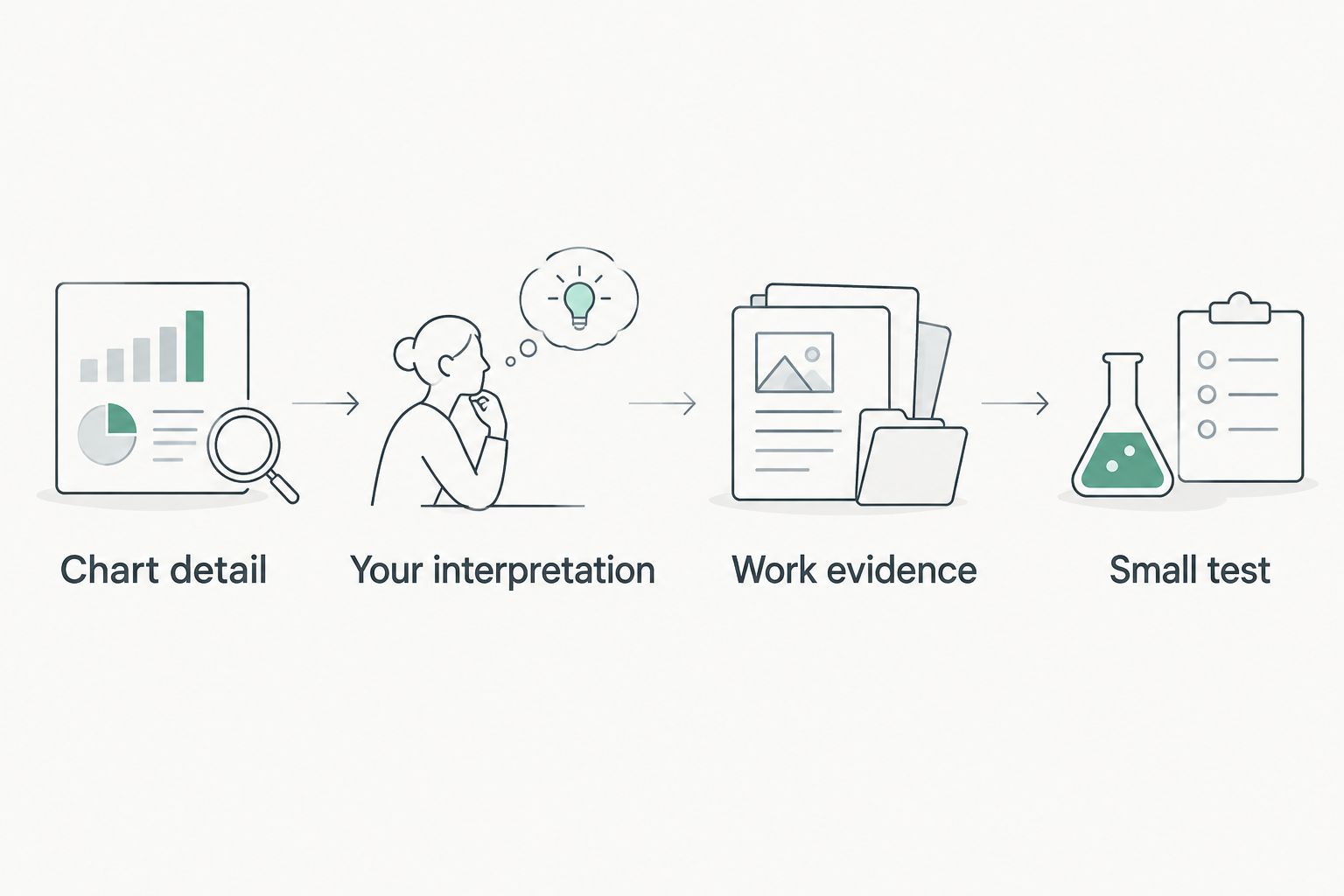
Astrofluence works best here as the start of a decision record. It cannot supply the response to your workload request or tell you whether a client will accept an offer. Put those answers in the journal when they arrive.
Start with one work question
Use a career read to frame a question, then test it in your journal.
Variant: journal after the work situation changes
The first workflow starts with a read and ends with a test. Reverse it when a real event arrives first. A rejected offer, a changed schedule, or a difficult conversation gives you fresh evidence before you look at the career read again.
- Record the event first. Write what was said or changed. Keep your account specific. “My manager declined the schedule change” is more useful than “Nothing ever changes here.”
- Reopen the same journal entry. Add the new event under Work evidence. Do not silently edit the earlier entry to make your first interpretation look right.
- Revisit the relevant part of the read. Ask whether your original prompt still helps. If your question was about work rhythm but the conversation exposed a problem with responsibilities, rewrite the question around the problem you can now name.
- Choose the next test. That might be a clearer request, a conversation about another role, or a draft offer you can show someone. Write the action and the next check-in date.
Expected result: Your 2026 journal shows how the question changed as evidence arrived. That is more useful than collecting chart interpretations without recording what happened at work.
This variant also prevents a common mistake: reopening the read only when you want reassurance. Start with the event. Write it down. Then use the read as a prompt, not as a way to overrule what the event showed you.
Troubleshooting
The birth time is uncertain
Do not write a precise chart-based conclusion from an estimated time. Record the uncertainty beside the input and avoid treating time-sensitive chart details as settled. You can still journal the work question and run a small workplace test without forcing a precise reading.
The read feels too broad
Narrow the question before writing more interpretation. “What should I do?” invites a long, vague entry. “Which responsibility should I discuss changing this week?” gives you a conversation to prepare. Select the part of the read that addresses that question and leave the rest for another day.
Your journal sounds like a prediction
Look for sentences that say an event will happen or that a placement requires a decision. Rewrite each as a question or an observation. “I will change jobs because of this chart” becomes “What evidence would make changing jobs a sound choice for me?”
You keep writing but do not act
Reduce the test. If “explore a career change” has sat in your journal for 1 week, replace it with a task you can finish by Friday, such as drafting 1 message to request a conversation. The purpose of the entry is to support a decision, not to become another task you avoid.
Friday brings mixed results
Record both sides. Your manager might reject one request but explain a responsibility you can change. A client might question your offer without rejecting the work. Write what happened before deciding whether the first test succeeded. Then choose whether to revise the test, ask another question, or stop.
Customize your workflow
Keep one journal entry per decision, not one entry per placement. That makes it easier to see whether you are repeatedly circling the same work problem. Give each entry a work question, a dated observation, and a next action. A simple 2026 review can then compare decisions you tested with ideas you only considered.
If direction is the question, use the career read to ask what kind of responsibility you want more of. If work rhythm is the issue, compare the prompt with a normal week rather than your worst Monday. If money pattern brings up your offer, draft the offer before you perfect its wording. Timing can help you choose when to review a decision; it does not guarantee an outcome.
For a wider decision framework, read the astrology for career decisions guide. Bring its questions back to your journal, then keep the action small. You do not need a new system every time the question changes.
FAQ
How do I start astrology career change journaling?
Start with one current work question, record the relevant chart detail separately from your interpretation, and choose one small test. Review what happened on a date you set in advance.
Can Astrofluence tell me whether to change careers?
No. Astrofluence provides a structured career read for reflection, not a prediction or a decision on your behalf. Check its prompts against your work evidence before you act.
Do I need a journaling app to use this workflow?
No. A notebook or document is enough because you transfer the relevant detail manually. Keep the question, chart detail, interpretation, evidence, and test together.
What should I write if my birth time is uncertain?
Record that uncertainty with your birth details and do not treat a time-sensitive chart detail as exact. You can still write about your work situation and test a practical question.
How often should I revisit my career read?
Revisit it when you have a specific decision or new work evidence to examine. Reopening the same read without recording an action does not tell you whether your interpretation was useful.
Should I journal about timing before accepting a job offer?
Journal the offer terms, your questions, and the conversations you still need first. Treat timing in the read as a reflection prompt, not a reason to accept or reject an offer.
What if my journal entry contradicts my chart interpretation?
Keep the workplace observation and revise the interpretation. The calculated detail and your meaning are different things; your interpretation is allowed to change when evidence arrives.
One last thing
Do not end your 2026 entry with “I understand myself better.” End it with a work question you can answer. By Friday, you can ask for a schedule change, show someone a draft offer, or learn why a role appeals to you. Your next journal entry should record the response, including the part you did not expect.