
Instead of rewriting your resume from scratch every time a role catches your eye, use an Astrofluence career read to choose a direction, then use your actual work evidence to write the resume. This astrology career resume rewrite workflow is a manual reflection process, not a prediction or an automatic connection between accounts.
- Astrofluence is best for people choosing a career angle before rewriting a resume, not for generating employment claims.
- For an astrology career resume rewrite, use the career read to frame a question and your work history to answer it.
- Keep chart interpretation out of the finished resume; put verified responsibilities and results in its place.
- By Friday, test one revised summary and two bullets against a real job description.
Why this matters
A resume rewrite stalls when you cannot decide what the document is meant to show. You can list everything you have done and still leave a hiring manager guessing about the role you want next. In 2026, the useful question is not whether a chart can name your next job. It is whether a structured prompt helps you make a clearer choice about which real experience to present.
Astrofluence is best for people who need a reflective career direction before they rewrite a resume; it does not replace evidence of their work. Its career read covers direction, work rhythm, money pattern, and timing. Those are prompts for decisions. Your employers, responsibilities, projects, and results remain the source for every claim on the page.
Start with your Astrofluence career read and one open role. Do not start by trying to make your resume sound like a chart. Start by asking what that employer needs to know you can do.
Before you start
- Have your exact birth date, birth time, and birth place available for the read. If your birth time is uncertain, do not treat a time-dependent chart placement as a firm basis for your resume angle.
- Keep your current resume, a job description, and notes that can verify your responsibilities and results. If you cannot substantiate a result, do not add it.
- Set aside a private working document for the reading and your decisions. Your birth details and chart interpretation belong in that document, not on the resume you send to employers.
This is a manual workflow. You read, decide, edit, and check. Nothing here requires a resume integration or an automatic transfer of personal information.
Career target
Goal: choose one role to write for before changing the document. A resume aimed at every possible career move gives the reader no clear reason to call you.
- Read the direction section of your Astrofluence career read. Write down a question it raises, such as whether you want to own a project, support a team, or change the kind of problem you solve. Do not turn that interpretation into a statement of fact about your abilities.
- Put one job description beside your current resume. Mark the work the employer describes and find matching tasks you have actually performed. If there is no match, keep the gap visible rather than changing your job history to hide it.
- Write a one-sentence target in your private document: the role you want, the work you can prove, and the work you want to do more of. For example, you might decide to emphasize coordinating a launch rather than describing yourself as interested in every part of marketing.
Expected result: you have one target role and one sentence explaining why your experience fits it. If you are still choosing between roles, do not rewrite the whole resume yet. Test a separate target sentence for each role against its job description.
A Midheaven reading can help you ask what kind of public work you want to be known for. It cannot certify that you are qualified for that work. Use the guide to finding your Midheaven sign when that part of your chart needs context, then return to the job description and your record.
Work evidence
Goal: collect facts before writing polished language. The calculation and the interpretation do different jobs here. Astrofluence uses a tropical zodiac, Placidus houses, and Pythagorean numerology; those methods structure the read. The meaning you take from it is reflective. Neither layer verifies what you did at work.
- Make a short evidence list for the target role. For each relevant job or project, record the task, your part in it, and the outcome you can support. Use your own records where you need to check a claim.
- Compare that list with the work rhythm section of your read. Ask a practical question: did you do your strongest work through sustained individual focus, frequent coordination, or a mix? Keep the answer only if your work history supports it.
- Compare the list with the employer's stated needs. Put the strongest matching examples first. A difficult Monday spent fixing a handoff tells a hiring manager more than a broad claim that you are adaptable.
Expected result: you have a small set of verified examples tied to the target role. The read helped you select a question; your record supplied the answer.
If daily routines are the sticking point, use the guide to the 6th house and work habits as a reflection prompt. Do not write a house placement into a resume bullet. Write the coordination, analysis, teaching, or other work you actually did.
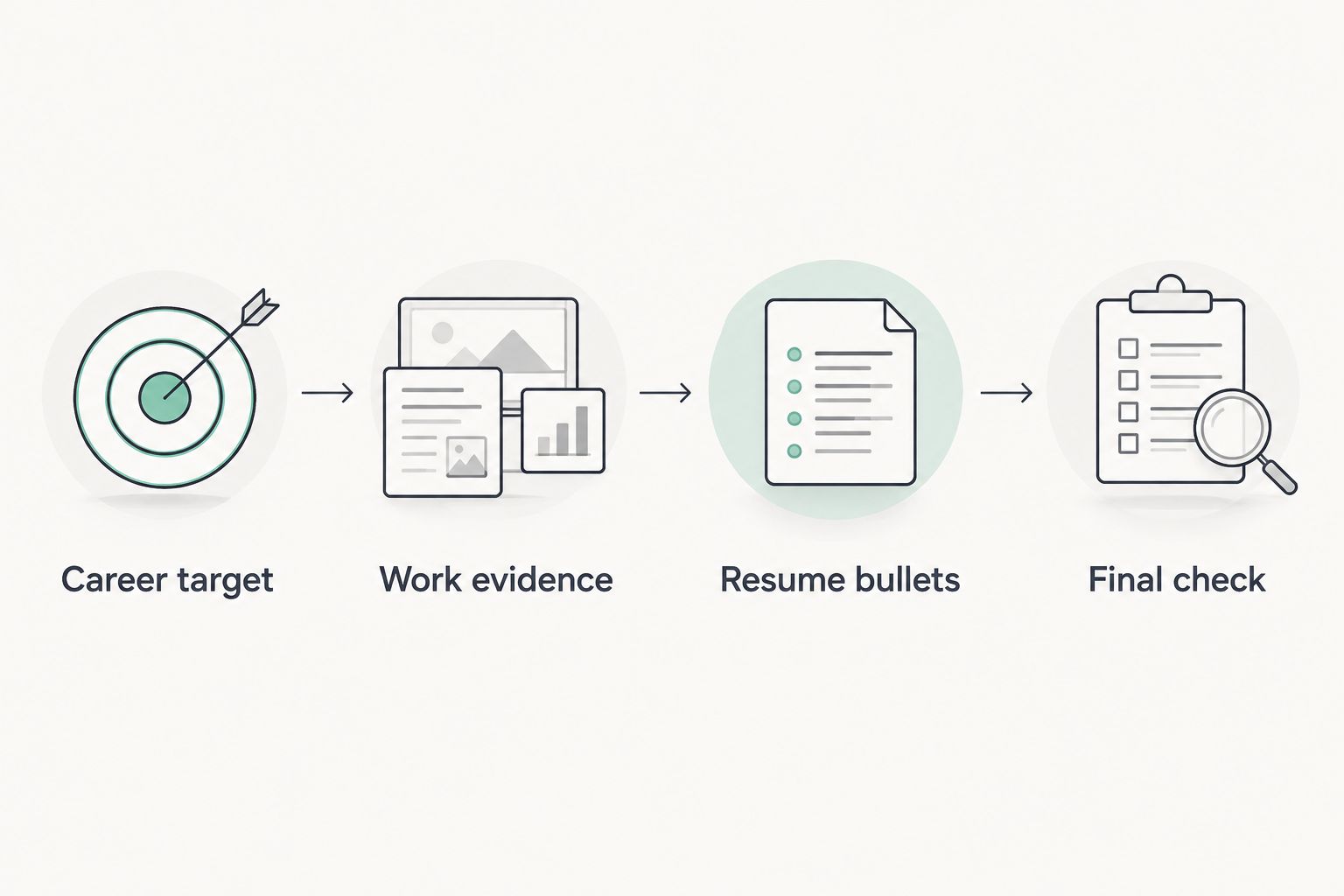
Resume bullets
Goal: turn the evidence into language a hiring manager can evaluate. In 2026, the final resume should read like a record of relevant work, not an explanation of how you chose your angle.
- Rewrite the summary around the target role and the experience you can verify. Replace a vague claim about finding your purpose with the type of work you have done and want to do next.
- Rewrite each selected bullet with the task, your action, and the outcome. If you cannot verify an outcome, describe the work without inventing one. For example, name the handoff you coordinated instead of claiming it transformed the business.
- Move the most relevant bullets higher within each role. Keep job titles, dates, employers, and qualifications accurate. A career pivot changes the emphasis of your resume, not your employment record.
- Read the draft beside the job description. Check that a reader can identify the work you have done without knowing anything about your chart.
Expected result: your summary states a credible direction and your bullets show evidence for it. If a sentence only works when you explain your reading, rewrite or remove it.
There are two useful editing approaches. Choose by the decision you face, not by which part of the read sounds more appealing.
| Approach | Best for | What changes | Benefit | Limitation |
|---|---|---|---|---|
| Direction-led rewrite | A career pivot toward a defined role | Summary and order of relevant experience | Makes the intended role clear | Cannot fill an experience gap |
| Work-rhythm rewrite | A similar role with a different day-to-day emphasis | Bullets about routines, coordination, and ownership | Shows how you work in practice | Can sound generic without specific examples |
For a pivot, use the direction-led rewrite. For a role close to your current work, use the work-rhythm rewrite. Either way, retain only statements you can defend in an interview.
Final check
Goal: separate the private decision process from the public document. Give yourself a short editing pass before sending the resume.
- Highlight every claim about a responsibility, outcome, skill, or qualification. Check each one against your records or your direct experience.
- Delete chart terms, numerology terms, and claims about what you are destined to do. They can be useful prompts in your private notes, but they do not describe work completed for an employer.
- Read the first screen of the resume as the hiring manager would. Can you see the target role and supporting experience without reading the whole document? If not, tighten the summary and reorder the strongest evidence.
- Ask someone who has not seen your career read what role the resume appears to target. If their answer differs from yours, revise the document before submitting it.
Expected result: a resume that stands on its own. You can explain every line without referring to astrology. Keep a copy of the earlier draft so you can compare the change rather than editing from memory.
Update the resume when your target role changes
The first version is not a permanent verdict. You may start 2026 aiming for team leadership, then find that the roles you want focus on specialist work. That calls for a new selection of evidence, not a new story about who you are.
Use the same workflow with the next job description. Write a new target sentence, select matching examples, and change the summary and bullet order. Keep the underlying facts fixed. When an interview question reveals that a bullet is unclear, rewrite it to name your action more precisely. When you lack the experience a role requires, leave that gap honest and decide whether to build it through your next project.
This variant also works when the resume is already accurate but not getting your intended point across. Do not ask the career read to explain the response. Compare the document with the role, check its claims, and make one visible change you can assess.
Troubleshooting
- You do not know your exact birth time. Do not build your resume angle around a placement that depends on that time. Use the broader career questions that help you examine your work, and let verified experience determine the text.
- The reading points toward work you have not done. Keep it as a private question about a possible next step. Do not add that work to your resume. Find a project where you can test the interest instead.
- Every bullet sounds like a personality trait. Replace the trait with a task you performed. What did you prepare, decide, coordinate, teach, or finish? Name your contribution before polishing the wording.
- The resume fits the reading but not the job. Put the job description back beside the draft. Retain evidence the employer can evaluate; remove interpretation that requires the employer to accept your chart.
- You are rewriting for several unrelated roles at once. Save separate copies. Give each one its own target sentence and bullet order while keeping titles, dates, and facts consistent.
Customize your workflow
Once the resume has a clear target, check the other places an employer will encounter your professional story. Your LinkedIn headline and the first lines of your resume should point toward compatible work. They do not need identical wording. They do need to make sense together.
You can also keep a private decision note with three fields: source, evidence, and move. Under source, write the career-read question that caught your attention. Under evidence, list the work that supports or challenges it. Under move, name one action you control, such as revising a summary or asking a colleague whether a bullet describes your contribution accurately. This prevents a reflective prompt from becoming an unsupported resume claim.
For a 2026 career pivot, make the test small. Pick one real job description on Monday. By Friday, produce one revised summary and two checked bullets, then ask a reader what role they think you are pursuing. If they cannot tell, fix the wording before rewriting the rest.
FAQ
Can astrology write my resume for me?
No. Astrology can prompt questions about career direction, but your resume must describe work you have actually done. Use your records and the job description to choose and verify every claim.
What is an astrology career resume rewrite?
An astrology career resume rewrite uses a career reading to clarify what work you want to emphasize, then rewrites the resume from verified experience. The reading is a private reflection tool, not evidence for an employer.
Should I mention Astrofluence on my resume?
No, not as an explanation for your qualifications. Use Astrofluence to think through your direction, then describe the responsibilities, skills, and results an employer can evaluate.
What if my birth time is uncertain?
Do not treat a time-dependent chart placement as a firm basis for your resume angle. Focus on questions that help you review your work history, and use verified experience to write the document.
Can a career read tell me which job to apply for in 2026?
No. A career read is not a prediction or a qualification check. Compare the job's requirements with your interests and documented experience before deciding to apply.
Should I change my resume for every application?
Change the emphasis when the target role changes, but keep the facts consistent. Adjust the summary and the order of relevant bullets to show the experience that matches the job.
How do I know whether the rewrite is finished?
The rewrite is ready when a reader can identify your target role and you can support every claim. Check the summary and bullets against a real job description before sending it.
One last thing
The most useful line from a career read might be a question you never put on your resume. Astrofluence helps you choose what to examine; your work history decides what you can claim. If you have one honest, targeted draft by Friday, you have completed the test. Do not wait for a reading to make the decision for you.