
Instead of translating a 10th-house read into career advice on your own, bring one work decision and your Astrofluence read to a coaching session. Use the read to frame a question, then use the session to choose a test you can complete by Friday.
- Astrofluence is best for people using 10th house astrology career coaching to examine a decision, not predict a job title.
- Bring one current work decision, the relevant part of your read, and evidence from your actual work.
- Ask your coach to challenge your interpretation and agree on one test you can finish by Friday.
- The chart calculation stays the same; a new decision gives you a new question to discuss.
Why this matters
The 10th house concerns public responsibility and career direction. That gives you a useful question for coaching: what kind of work do you want to be known for, and what responsibility are you willing to take on? It does not tell you which offer to accept or what title to put on your profile.
Astrofluence is best for people who want a structured career reflection to bring to an independent coach, not a predicted job title. Its calculation uses your exact birth date, time, and place, with a tropical zodiac and Placidus houses. The calculation is repeatable. The meaning you draw from it needs to face your work history, constraints, and choices.
In 2026, you might be deciding whether to manage a team, change fields, or put your name on a client offer. A coach can help you inspect the evidence behind that decision. Your read supplies a prompt, not an instruction. If the prompt conflicts with what you know about your job, bring the conflict into the room.
Before you start
- Have your exact birth date, time, and place ready. Astrofluence uses all three for the chart calculation. If you are unsure of your birth time, resolve that before treating a house-based read as settled. Do not replace an unknown time with a guess and call the result precise.
- Choose one live decision. Write it as a choice you can discuss: “Do I ask to lead the next project?” works better than “What is my destiny?” Bring any relevant job description, client feedback, or examples of work you have done.
- Agree on the session’s purpose with your coach. Ask whether they are willing to work with a reflective prompt you bring. They do not need to interpret astrology. They do need to help you test your assumptions against your goals and circumstances.
The easy mistake is to send a full read and expect your coach to find the question. Pull out the passage about your 10th house, then write the decision beside it. You can share that excerpt without sharing your birth details if those details are not needed for the conversation.
Prepare the 10th-house read
- Generate your read using the correct birth details. Check the date, time, and place you enter against your source. Keep calculation separate from interpretation: the chart describes placements under a stated method; it does not verify a career outcome.
- Find the part about career direction or public responsibility. Mark one line that gives you a question about your work. Do not copy every sentence into your coaching notes. One passage is enough to start a useful discussion.
- Translate that passage into a decision question. If you are considering a management role, ask, “What would I have to own each Monday in this role?” If you are considering a career pivot, ask, “Which part of my current work do I want to carry into the next role?”
- Write down what the read cannot tell you. It cannot establish whether a manager will approve a move, whether a role fits your schedule, or whether a client will accept an offer. Those questions need conversations and evidence outside the chart.
Expected result: You have one marked passage and one career question. If you still have several competing questions, choose the decision with an action you can take by Friday. You can revisit the others in a later session.
Build the coaching brief
Give your coach a short brief before the session or bring it with you. Use four labels: Decision, Evidence, Question, and Test. This keeps a 2026 coaching conversation anchored in your work rather than in a broad description of your personality.
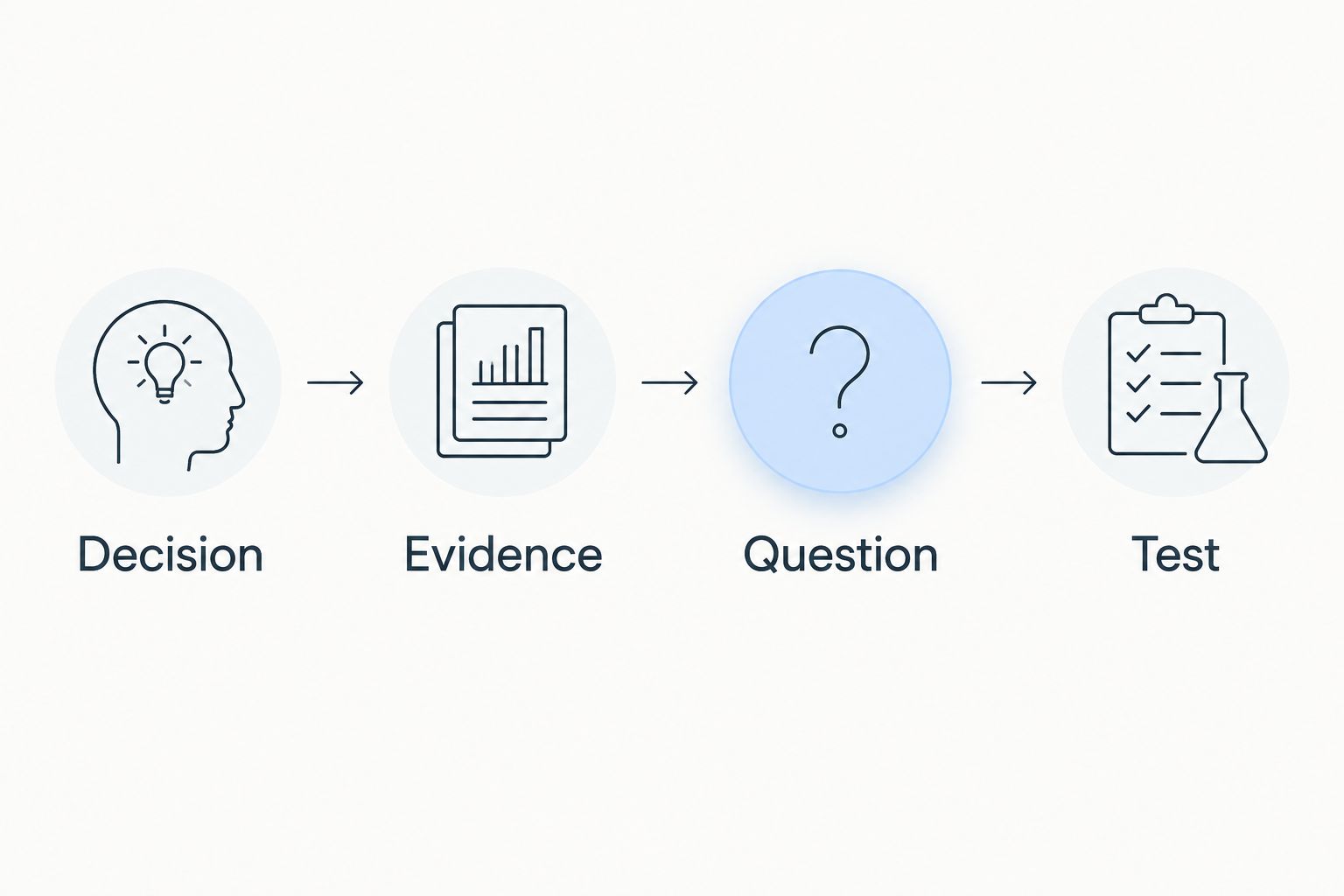
- Decision: Name the choice in one sentence. “I am deciding whether to apply for a team lead role” is specific. “I need career clarity” leaves your coach to guess what is at stake.
- Evidence: Bring two examples from work that pull in different directions. You might enjoy presenting a project to stakeholders but dread managing the weekly schedule. Both facts belong in the conversation. Do not select evidence only because it supports the interpretation you liked.
- Question: Add your marked 10th-house passage, then ask what it helps you examine. “Where do I want public responsibility?” invites a useful discussion. “Does my chart say I will get promoted?” asks the read to predict an outcome it cannot establish.
- Test: Suggest one small action. Ask to lead a meeting, speak with someone in the role, or draft the offer you have delayed sending. The session can change that test once you inspect the real constraints.
Expected result: Your coach can see the choice, the evidence, and the role the read plays before discussing next steps. The brief does not need to persuade them that the interpretation is true. It needs to show what you want to investigate.
If your issue is a difficult Monday rather than a career pivot, say so. Public responsibility and daily workload are different questions. A role can fit the reputation you want and still demand a routine you do not want to repeat. Take both sides into the session instead of forcing one chart theme to answer everything.
Run the session and record the test
- Open with the decision, not the chart. Tell your coach what you need to choose in 2026 and when you need to choose it. Then share the marked passage as a prompt for reflection. This gives the conversation a practical starting point.
- Ask the coach to separate observation from interpretation. What have you actually done at work? What do you think the 10th-house passage means? Which part of that meaning still needs testing? Your coach can question the interpretation without disputing the calculation.
- Examine the trade-off. If you want a more visible role, ask what it would add to your week and what it would displace. If you want to publish a new offer, ask who will review it and what response would help you decide. A useful coaching session makes the next decision smaller.
- Agree on one action and a check-in. Record what you will do by Friday, what you expect to learn, and what would change your mind. Ask your coach to hold you to the action, not to a chart-based outcome.
Expected result: You leave with a test written in ordinary work language. “Ask my manager what leading the next client meeting would involve” is a test. “Become the leader my chart shows” is not. If the first test fails, you still learn something you can bring to the next conversation.
For a 30-minute session, you can propose spending 5 minutes naming the decision, 15 minutes examining evidence and trade-offs, and 10 minutes choosing the test. Those are planning blocks, not a requirement for coaching. Adjust them with your coach, but protect time for the final action. A conversation that ends at interpretation has not yet helped you choose.
Bring the same read to a follow-up session
You do not need a new birth chart every time your work changes. The birth details and calculation remain the same; the decision you bring to coaching changes. That is the useful second workflow for a follow-up in 2026.
Start with the action from your previous session. Say what you did, what happened, and what surprised you. If you asked to lead a meeting, did the responsibility appeal to you once you saw the preparation it required? If you drafted a client offer, what feedback did you get before launch? Your coach now has observed work to discuss, not just a possible direction.
Next, return to your original 10th-house question. Keep it if it still helps you examine public responsibility. Change the question if your test exposed a different issue, such as workload or resources. Do not describe that change as the chart changing or predicting the result. The same read can support a different conversation without becoming a different calculation.
Finish the follow-up with another Friday-sized test. You might ask to shadow part of a role, revise a draft offer, or block time to compare the duties of two positions. Pick the action that would give you information you do not already have. Your coach can help you decide what counts as evidence before you take it.
Troubleshooting
The birth time is uncertain
Pause before relying on a specific house placement. Astrofluence uses exact birth date, time, and place for its structured read, so a guessed time does not satisfy the stated inputs. You can still discuss the career decision with your coach. Bring the work evidence now and return to a house-based question when you have reliable birth details.
The coach does not use astrology
Ask them to treat the passage as a question you chose, not as a finding they must endorse. “I want to talk about the kind of responsibility I seek” is a coaching topic on its own. If your coach prefers to work only from goals and observed behavior, use those and leave the chart outside the session.
The read sounds like an answer
Rewrite it as a question before the session. A passage about career direction does not decide whether you should quit, accept a role, or launch an offer. Ask which part matches your experience, which part does not, and what evidence would help you choose.
The conversation stays abstract
Return to a calendar, a task, or a person you can speak to. “I want more visibility” becomes “I will ask to present the project update.” “I need better timing” becomes “I will ask what must be ready before I announce the offer.” The Friday test is the bridge between reflection and a decision.
The coach and the read point in different directions
Do not make either one the final authority. Ask what evidence your coach is using and which assumption you brought from the read. Then choose a small test that puts the disagreement in contact with your actual work. The goal is a better decision, not agreement with a passage.
Customize your workflow
A 10th-house question works best when it addresses the decision in front of you. For a promotion, examine the responsibility attached to the title. For a pivot, examine which work you want people to seek you out for. For a launch, examine what you are willing to put your name on before you spend another Monday polishing it.
Use other parts of your read only when they answer a distinct question. Work rhythm, money pattern, and timing are separate topics in Astrofluence’s career read. Do not treat one 10th-house passage as an answer to workload or income decisions. If your coaching question spans several parts of work, the guide to astrology for career decisions gives you a broader way to frame it.
Keep a record with your decision, the passage you used, the evidence you brought, the test you chose, and what happened. At your next session, lead with what happened. The notes make it easier to tell the difference between an interpretation that prompted a useful question and a claim that never met the facts of your working week.
FAQ
How do I use a 10th-house read in career coaching?
Bring one current career decision, one relevant passage, and evidence from your work. Ask your coach to help turn the passage into a question and choose a small test you can complete by Friday.
Does my 10th house tell me which career to choose?
No. The 10th house gives you a way to reflect on career direction and public responsibility, not a fixed job assignment. Check any interpretation against your skills, constraints, and experience.
Does my career coach need to know astrology?
No. Your coach can work with a question about responsibility or direction without interpreting a chart. Explain that the read is a reflective prompt, not evidence of what will happen.
What should I share with my coach from Astrofluence?
Share the passage relevant to your decision and a short explanation of why it stood out. You can keep your birth details private if they are not needed for the coaching conversation.
What if I do not know my exact birth time?
Do not treat a guessed birth time as exact input for a house-based read. Discuss the work decision using your experience and return to the chart question when you have reliable birth details.
Can I use the same read for another coaching session?
Yes. Your birth details and chart calculation do not change when you start a new work project. Bring the result of your last test and ask a new question about the decision you face now.
What should I do after a 10th-house coaching session?
Complete the one work test you agreed on and record what happened. Take that result to your next conversation before drawing another conclusion from the read.
One last thing
If you leave the session with a more elaborate description of yourself but no action, ask one more question: “What can I check by Friday?” In 2026, Astrofluence’s 10th-house read is most useful when it helps you name a real choice. The coach helps you test it. You still make the decision.