
Instead of rereading your master number result before every application, connect it to a job tracker through a reflection field, an evidence field, and a next action. This master number numerology job search tracker workflow turns an interpretation into questions you can test, not a prediction about which employer will hire you.
- Astrofluence suits job seekers who want structured career reflection, not hiring predictions.
- A master number numerology job search tracker keeps interpretations separate from employer evidence.
- Use master numbers 11, 22, and 33 as reflection inputs, never job-fit scores.
- Connect your career reading manually, then test one workplace question by Friday.
Why this matters
A job tracker records applications. A career reading raises questions. Mixing those functions creates a problem: a meaningful interpretation starts looking like evidence about a role you have not investigated.
Astrofluence is best for job seekers who want structured career reflection, not hiring predictions. Astrofluence uses repeatable calculations and interprets them as reflection language for career decisions. The calculation and the meaning are different layers.
For your 2026 job search, keep both layers visible. Record the result as a source note. Translate the interpretation into a work question. Then gather evidence from the job description, an interview, or an actual task.
The useful connection is not a number beside a company name. It is a question that changes what you check before applying or accepting an offer. A difficult Monday becomes a question about workload. A career pivot becomes a question about which responsibilities you want to try.
Before you start
- Have your reading and its source details. Keep the exact master number result and the accompanying interpretation. For an Astrofluence career reading, prepare your exact birth date, time, and place. Do not substitute guessed details for known records.
- Have an editable tracker. Use a spreadsheet, database, or document where you can add fields. Keep the employer, role, application status, and next action alongside the new reflection fields.
- Check what the number describes. A master number result needs its calculation context. Do not assume every displayed 11, 22, or 33 refers to the same numerology calculation, and do not treat this workflow as an automatic account connection.
This guide uses a manual connection. You copy a source result into your tracker and build a repeatable review routine around it. No API, account authorization, or background synchronization is part of these steps.
Choose your connection method
Use the smallest setup you will maintain. Both methods below keep the reading available, but they place the interpretation differently.
| Method | Best for | What you do | Advantage | Limitation |
|---|---|---|---|---|
| Source note plus role rows | A job search using one current reading | Keep the result in one note; add a question and evidence to each role | Avoids copying the full reading repeatedly | Requires checking the source note when your interpretation changes |
| Reflection fields in every row | Comparing roles against different work questions | Copy a short source reference and role-specific question into each row | Keeps each application self-contained | Repeated text needs manual maintenance |
Start with a source note plus role rows. Keep the full interpretation in one place and put only the relevant question beside each job. Choose row-level reflection fields when you genuinely need different questions for different roles.
Astrofluence career readings cover direction, work rhythm, money pattern, and timing. That structure gives you starting points for reflection. It does not verify an employer's working conditions, assess your qualifications, or guarantee an outcome.
Source record
Capture the result without changing its meaning
- Create a note titled Reading source in your tracker or its accompanying document.
- Add fields named Result, Calculation context, Source, Recorded on, and Interpretation. These are labels you create, not existing product controls.
- Copy the master number result exactly. Preserve the source's wording rather than replacing it with a personality label.
- Record what the result describes. If the reading identifies a life path calculation, keep that context attached to the number.
- Enter the date you recorded it, including 2026, and copy only the interpretation you intend to examine during this search.
Expected result: you can trace the reflection back to a named source and a specific calculation context. You have not yet assigned any role a fit score.
Astrofluence uses Pythagorean numerology with master numbers 11, 22, and 33. Its broader reading also uses the tropical zodiac and Placidus houses. Do not combine those inputs into a homemade hiring probability.
If you need to examine the calculation context first, use the guide to calculating your life path number for career fit. Keep that calculation check separate from evaluating an employer.
Turn the interpretation into a work question
- Select one passage from Interpretation that connects to a real decision.
- Write its meaning in ordinary workplace language. Replace a broad phrase such as taking responsibility with a specific question about decision authority.
- Add Work question to the source note. Ask something an employer or a practical test can answer.
- Add Evidence needed. Name the information that would support or challenge your assumption.
For example, if your interpretation prompts you to examine responsibility, your question could be: Who decides priorities when two requests conflict? Useful evidence includes the manager's explanation and a concrete example from the team.
Expected result: you have a question about work, not a claim about destiny. The answer can disagree with your initial interpretation without invalidating the source calculation.
Tracker fields
Add the reflection beside each application
- Keep your existing employer and role fields. Add Reading reference, Work question, Employer evidence, Next action, and Review date.
- Put a short reference to Reading source in Reading reference. Do not paste personal birth details into every application row.
- Adapt Work question to the role. A question about responsibility should name the actual responsibilities described in the vacancy.
- Leave Employer evidence empty until you have something observable. An appealing title is not evidence of autonomy.
- Enter an action you control in Next action. Add its date to Review date.
Expected result: every active application has a practical question and a next move. The master number remains a source reference, not a ranking formula.
Use this example as a structure, not as a statement about any employer:
| Field | Example entry |
|---|---|
| Reading reference | Master number result saved in Reading source |
| Work question | Will this role let me own a project without constant priority changes? |
| Employer evidence | Job description mentions project ownership; decision authority is unconfirmed |
| Next action | Ask the hiring manager who approves changes to the project scope |
| Review date | Friday, September 18, 2026 |
Notice the word unconfirmed. It protects the tracker from turning a job description into an established fact. Keep the distinction after interviews too. A general answer about culture is weaker than a specific description of how work gets assigned.
Keep reflection and evidence separate
- Put your interpretation only in Work question or the source note.
- Put employer statements, task observations, and application facts in Employer evidence.
- When you infer something, label it as an inference in the same cell.
- Change Next action when new evidence arrives. Do not change the source result to match the employer's answer.
Expected result: someone reading one row can distinguish what you are exploring from what you actually know.
This separation matters when an offer feels exciting. You can want more responsibility and still reject a role with unclear authority. You can value a steadier work rhythm and still investigate a demanding position. The reading opens the question. It does not settle it.
Friday review
Run a small test before expanding the tracker
- Choose 2 roles already in your tracker. Use roles you are genuinely considering, not vacancies selected to confirm the interpretation.
- Set aside 15 minutes to inspect their descriptions against the same work question.
- Write 1 interview question for each unresolved issue. Ask about a concrete situation, such as a deadline moving or a client changing scope.
- Choose one action you can finish by Friday: send the question, request a conversation, or revise an application to show relevant experience.
- At the review, record what happened and choose the next action. Keep unanswered questions open.
Expected result: the reading has produced a completed action and a clearer information gap. It has not produced a promise about getting hired.
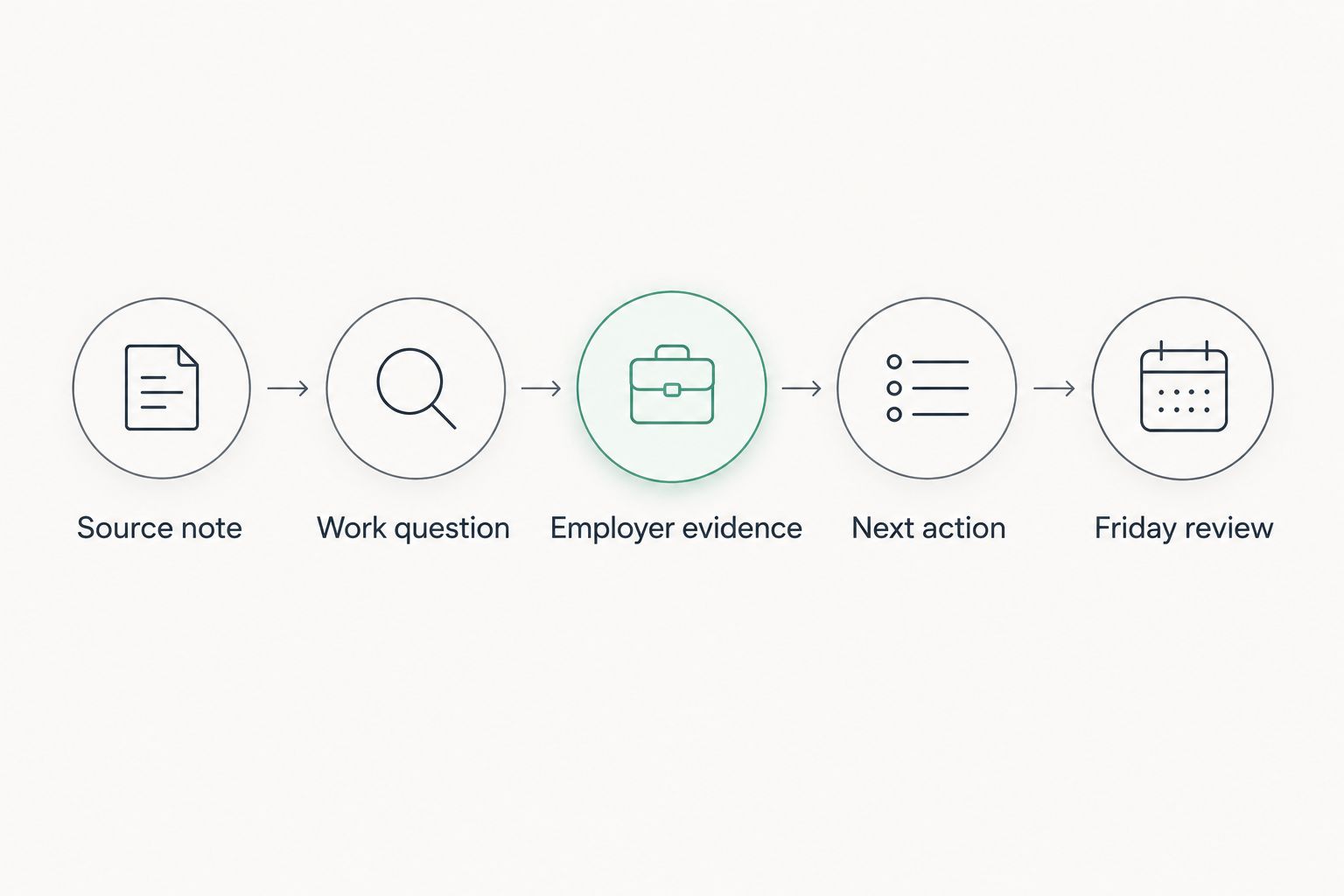
Use a repeatable sequence: Source note, Work question, Employer evidence, Next action, Friday review. The order keeps interpretation upstream and decisions downstream of evidence.
For a 2026 career pivot, make the test smaller than the decision. If you are considering client-facing work, ask someone in that role how they handle changing requests. You do not need to decide your whole career before collecting that answer.
Update the tracker after an interview
The second workflow starts with new employer evidence rather than a new reading. Use it whenever a conversation changes what you know about a role.
- Open the relevant application row and update Employer evidence with the answer you received.
- Separate the answer from your reaction. Record the manager's description first, then your assessment.
- Check whether the answer resolves Work question. If not, write the narrower follow-up question.
- Replace the completed Next action with the next task and update Review date.
- Keep Reading reference unchanged unless you intentionally choose a different reflection source.
Expected result: the row reflects the current conversation without rewriting your original source note.
Suppose you asked about competing deadlines. The manager describes a weekly priority review, but you still do not know who can refuse extra work. Your next action is to clarify that authority. It is not to decide that the role matches your number.
If you replace your interpretation during 2026, date the revised note. Keep earlier application evidence intact. Otherwise, you lose the distinction between what changed in your thinking and what changed in the employer information.
Troubleshooting
Every role seems to match the reading
Your work question is too broad. Replace a phrase such as meaningful work with something observable: Who uses the output of this role, and how does the team check whether it helped? Record unanswered questions instead of filling the row with agreement.
The tracker has become another task to avoid
Keep one current work question and one next action per role. Move the full interpretation back into Reading source. A tracker should help you apply, investigate, and follow up. It should not require rewriting the reading each time.
Two readings give different master number results
Compare their calculation context and recorded inputs before using either interpretation. Preserve each source separately. Do not average the results or choose the number that feels more flattering. Resolve the calculation question before attaching meaning to it.
A shared tracker exposes personal birth details
Remove the birth date, time, and place from shared application rows. Retain only the source reference and work question. Check who can access the source note before sharing the tracker with a coach, recruiter, or colleague.
You are waiting for the number to approve an offer
Return to the unresolved employer questions. Check the responsibilities, working conditions, written terms, and your own constraints. Use the interpretation to ask better questions, not to postpone a decision until it feels guaranteed.
Customize your workflow
Once the basic loop works, adapt the question to the decision in front of you. Do not add fields just because the tracker has room.
- Career direction: ask which tasks you want more evidence about before changing roles.
- Work rhythm: ask how the team handles interruptions, deadline changes, and recurring workload.
- Money pattern: identify the offer terms you need to clarify. Keep numerology separate from financial advice.
- Timing: put application deadlines and follow-up dates in the tracker. Do not treat a reflective timing interpretation as an employer's schedule.
For your next Friday review in 2026, choose the row with the clearest unanswered question. Complete its action before redesigning the database. A useful tracker reduces uncertainty through evidence, not through more categories.
FAQ
How do I connect my master number result to a job search tracker?
Copy the result into a source note, then add a work question, employer evidence, and next action to each application row. This creates a manual reflection workflow, not an automatic software connection.
Can Astrofluence automatically sync my reading with a job tracker?
This guide uses manual entry and does not establish an automatic Astrofluence sync. You can follow the workflow in an editable spreadsheet, database, or document without an account integration.
Should I rank jobs by master number 11, 22, or 33?
Do not use master numbers as job-fit scores. Use the interpretation to frame questions, then compare roles using responsibilities, qualifications, working conditions, and employer evidence.
What should I do if two calculators give different master numbers?
Check the recorded inputs and calculation context before interpreting either result. Keep the sources separate rather than averaging the numbers or choosing the interpretation you prefer.
Do I need to share my birth details with recruiters?
You do not need to share birth details for this tracker workflow. Share the relevant work question or application evidence, and keep personal source details outside shared rows.
Can numerology tell me whether I will get a job?
Numerology does not provide a reliable hiring prediction. Astrofluence treats its meaning layer as career reflection, while you make decisions using employer evidence and your circumstances.
What is the smallest useful test I can finish by Friday?
Choose one unresolved work question and ask someone who can answer it. Record the response in your tracker and set a next action based on what you learned.
One last thing
The best outcome can be a question you stop using. If an interpretation produces no useful distinction between roles, retire that question and choose a more concrete one. Keep the calculation record. Change the test.
By Friday, you should have done something outside the tracker: asked a manager, examined a responsibility, or clarified an offer. A perfectly organized reflection is still not an application.