To price a creative project, add up the income you need and divide it by the hours you can bill. That gives you an hourly floor. Then price the specific job, including the work and how the client will use it. If you're good at spotting details other people miss, use that skill on your own week. Count the emails, revisions and admin before you quote. The worked example uses hypothetical numbers in US dollars.
What you'll need

- An income goal. The annual amount you want left for yourself after setting aside business costs and taxes.
- Last year's expenses. Software, gear, internet, insurance, workspace, training.
- A time log. A time-tracking app or a simple spreadsheet showing where your hours went.
- A list of past projects. What you charged, how long each took, how many revisions happened.
- A contract template. Somewhere to write scope, revisions and usage terms.
- An invoicing tool. Anything that sends clear invoices with due dates.
If you don't have a time log yet, estimate honestly and start tracking this week. Your second pass will be sharper.
Before you start
Write down what the client needs before you offer a fixed fee. Ask which uses the price needs to cover before you include broad rights. If you're offering a discount, state which quote it applies to and when it ends.
So decide your floor price first: the lowest rate you'll accept on any project. Write it down. Every quote below starts from there.
Step-by-step: set your price
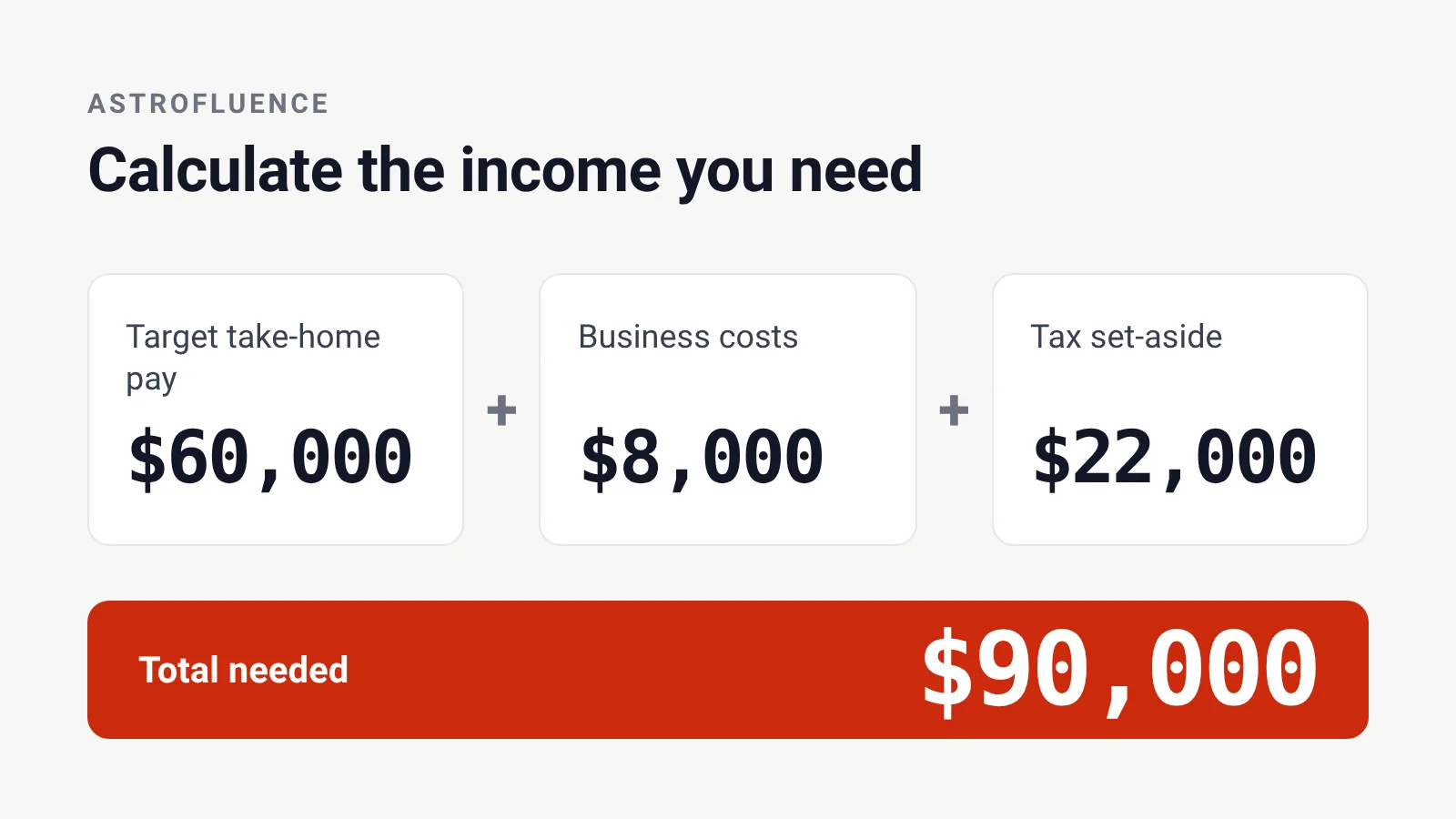
1. Calculate the income you need
Add the amount you want to keep, your yearly business costs and your own estimate for taxes. If your income feels uncertain, choosing a side hustle can be a separate question.
Check: you have one yearly number that covers pay, costs and tax.
2. Count your real billable hours
A 40-hour workweek can include far fewer billable hours. Email, marketing, invoicing and learning all take time. Look at your time log and count the hours that went straight into client work. Leave vacation, holidays and sick days out of the weeks you expect to work.
Check: you have a yearly billable-hours figure that matches what your log shows, not what you hope.
3. Turn it into an hourly rate (worked example)
Here’s a hypothetical example in US dollars. Use your own numbers, including your own tax estimate.
| Item | Hypothetical assumption |
|---|---|
| Target take-home pay | $60,000 |
| Business costs | $8,000 |
| Tax set-aside | $22,000 |
| Total needed | $90,000 |
| Working weeks | 46 (6 weeks off) |
| Hours worked per week | 40 |
| Share of time that's billable | 50% |
| Billable hours per year | 920 |
Divide $90,000 by 920 hours and you get about $98 an hour. Round it to $100. In this example, that's the floor.
Now a project quote. Say this freelancer estimates a logo package at 20 hours. At $100 an hour that's $2,000. Add a buffer for revisions and back-and-forth.
Check: you can explain how you calculated your hourly floor.
4. Convert to a project fee
A fixed fee gives the client a total upfront. Estimate the hours, multiply by your rate and add time for changes. List what you'll deliver, the number of revisions and the deadline. Hourly billing can fit open-ended work. A fixed fee works best when both sides can agree on the scope.
Check: your quote lists deliverables and a revision count, not just a number.
5. Price for usage and value
Time is only part of the story. A client might need the same design for one social post or for packaging sold nationwide. Ask how and where the work will be used, for how long, and what it helps the client earn or save. Consider a separate price for wider, longer or exclusive use. When pricing for value, consider what the result is worth to this client alongside the time it takes you.
Check: your contract names the usage the fee covers.
6. Frame the money conversation
Say what the fee covers, then give the client room to respond. Here are three ways to say it:
- "For this scope, the fee is $2,300. That includes two rounds of revisions."
- "If the budget is tighter, we can trim the scope. Want me to show you a smaller version?"
- "I’ll confirm an estimate at my hourly rate before starting extra rounds."
If the client needs a lower total, start by discussing what you can leave out.
Check: you can say the fee and what's included in one sentence.
7. Put it in writing and review it
Send a short proposal or contract with scope, fee, revisions, usage, payment terms and deadline. After the project, compare estimated hours to real hours and update your next estimate.
Check: every live project has signed terms, and you've noted actual hours for each finished one.
Spot the undercharging patterns

Quoting before you know the scope
If you give a number on the first call, you're guessing. Fix: say "I'll send a quote once I've seen the brief," then ask about deliverables, deadline and usage.
Skipping revision limits
Unlimited revisions turn a fixed fee into an open tab. Fix: include a set number of rounds and a rate for extras.
Discounting to win work
A quick yes tells you little on its own. Check how much you made for the actual hours before you offer another discount. Fix: stop opening with discounts. Offer a smaller scope instead.
Never raising rates
When your costs rise, the same fee leaves you less after expenses. Fix: put a yearly rate review on your calendar.
Test your pricing with a small step

You don't need to email every client a new rate tomorrow. Try it on the next new client only. Quote your updated rate, note their response and whether they sign, then adjust. Compare the response and the hours you end up spending with your estimate.
If you tend to lower a quote before the client responds, note what prompted you. You can use your money pattern as a prompt for that reflection. The guides to Venus, career and money and career astrology for freelancers offer more questions to consider. Work out the fee from your costs, hours and scope.
Troubleshooting
Symptom: clients say your quote is too high
Cause: the client may want a smaller job or may not see what's included. Fix: narrow the scope or offer tiers, such as basic, standard and full, so they pick a level instead of haggling the rate.
Symptom: projects keep running over
Cause: loose scope and no limit on changes. Fix: add change-order terms. New requests get a written mini-quote before you start them.
Symptom: you can't hit your income goal
Cause: your fee and billable hours may leave you short of your goal. Admin may also be taking more time than you planned. Fix: raise your rate on new work, or cut non-billable time with templates and batched admin.
FAQ: Frequently Asked Questions
How much should I charge as a freelance graphic designer?
Start from your own numbers: income needed, business costs, taxes and real billable hours. That gives your floor. Then adjust each quote for scope, usage rights and the value the design brings the client.
How do I price things I make?
Add up materials and your time at your hourly floor, then allow for a profit. If your hourly floor already includes overhead, avoid counting those costs twice. Check what buyers are willing to pay.
What are seven ways to set prices?
Seven options are marking up costs, pricing for value, comparing competitors’ prices, offering tiers, charging a regular fee for ongoing work, billing by the hour and quoting per project. Many freelancers mix them, for example quoting per project, offering tiers, and moving steady clients onto a monthly retainer.
Show more questions
Should I charge hourly or per project?
Hourly fits open-ended or unclear work. Per project fits work you can scope clearly, and gives the client a total upfront. Either way, know your hourly floor so every project fee sits above it.
How often should I raise my rates?
Review your rates at least once a year, and sooner if you're always booked or your costs rise. Apply new rates to new clients first, then give existing clients notice before changing theirs.
Conclusion
Set your hourly floor and use it on your next new quote. Note how the client responds and compare your estimated hours with your time log if the work goes ahead. If you want a prompt about how you handle money conversations at work, explore your money pattern in your reading. Read my chart for free.
Want the next post when it's out? Follow by RSS