Start with a side hustle that uses a skill you already have, fits your real free hours and costs little to test. Your useful work pattern might be explaining things clearly, fixing a practical problem or keeping details in order. Check that pattern against work you've actually done. This guide helps you turn it into a small offer, compare ideas and test one before spending more. An optional Astrofluence read can add questions about how you work: Read my chart for free.
What you'll need

- Your real weekly hours. Not the hours you wish you had. The ones left after work, family, sleep and errands.
- A skills list. Things you already do well, at work or outside it.
- A small test budget. An amount you could lose without stress.
- A notes app or spreadsheet. You'll score ideas and track a short test.
- Optional: your birth date, place and time.
Before you start
Some choices are hard to undo. Hold off on quitting your job, buying lots of stock or paying for a course until you've tried a small version of the idea. Set a limit on the time and money you're willing to spend. Check any work-contract or local requirements that apply to the activity. Neither this exercise nor a chart read promises income. You choose what to try.
Step-by-step: pick your side hustle
1. Count your real weekly hours
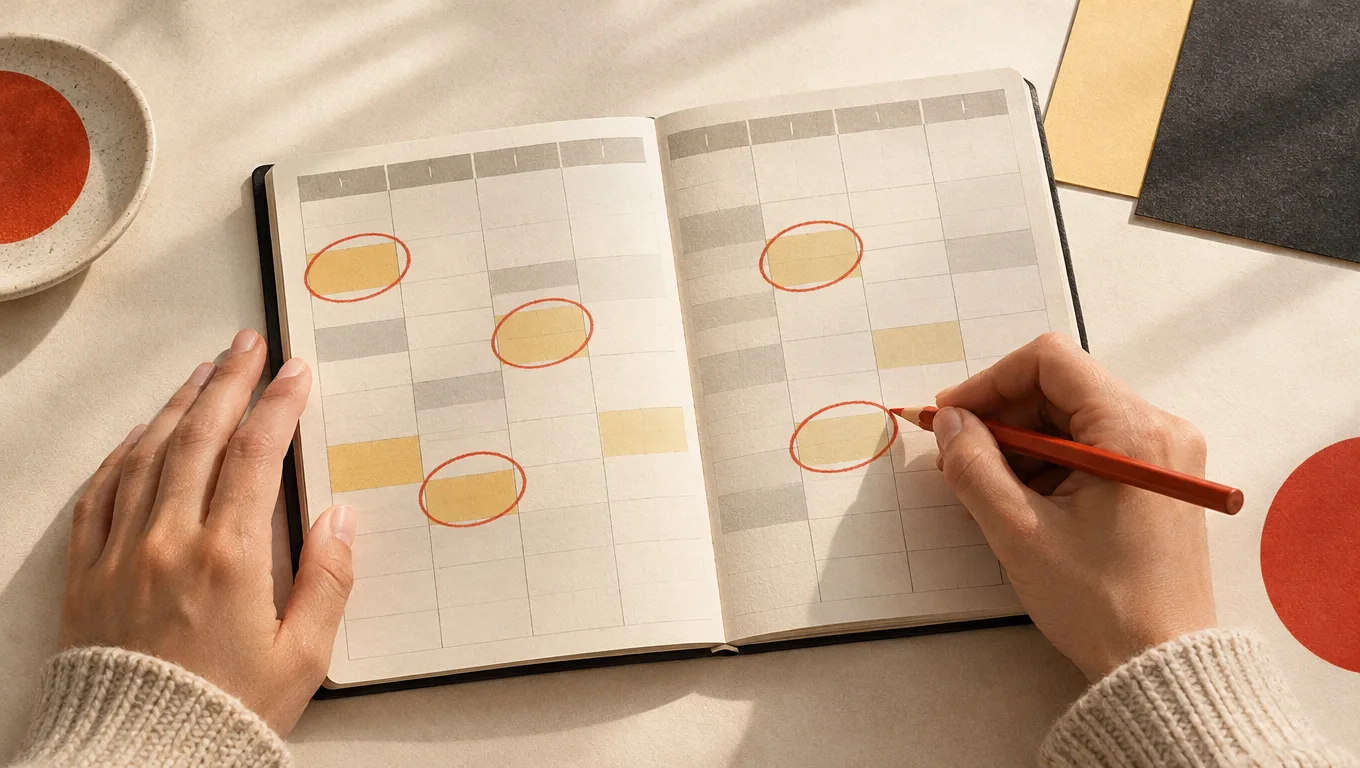
Write down every block of free time in a normal week. Be honest about energy too: two hours after a draining shift aren't the same as two fresh Saturday hours. Add them up and circle the blocks where you'd actually get things done.
Check: You have one number (say, a hypothetical 6 hours) and you know which days those hours live on.
2. List skills people already pay for
List what you do well, then mark the ones someone already pays for somewhere: editing, fixing bikes, bookkeeping, baking, tutoring, video edits, organizing closets. You aren't hunting for a hidden talent. You're looking for something useful you can already deliver this month.
Check: At least five skills have a mark next to them.
3. Name your money goal without a promise
A goal is fine, but treat it as a direction, not a guarantee. What you earn depends on your skill, your hours, what people nearby or online want, and how you price. Write your goal as a reason: pay off a card, build a buffer, test a business idea.
Check: Your goal fits in one sentence and includes why you want it.
4. Use your chart as one input
This step is optional. A birth chart gives you symbols to reflect on, not evidence of what you can do. For example, the 6th house, one of the chart's twelve sections, is a traditional prompt about daily work. Compare any question from a read with your actual habits. These are questions for this exercise, not a promise that each one appears in your free read:
| Read area | Side hustle question to ask yourself |
|---|---|
| Career direction | Which kind of work do I want more of, making, helping, teaching or selling? |
| Work rhythm | Do I work best in short bursts, steady routines, or deep solo sessions? |
| Money pattern | Do I prefer steady small payments or occasional bigger projects? |
| Timing | What feels worth trying now, and what can wait? |
Use the money-pattern question to look at how you'd handle pricing, payment gaps and the time spent chasing invoices. A preference for steady payments doesn't tell you what customers will buy. Check that separately by asking possible customers what they need and what they already pay for.
A chart is a lens, not a prediction of income or proof of skill. If your birth time is unknown, don't use house placements or the chart's career angle as reliable personal evidence. An assumed midday time cannot recover the missing information. You can still work through the hours, skills and customer questions in this guide.
Check: You've written two or three questions from the read next to your skills list, and you agree or disagree with each in your own words.
5. Shortlist three ideas and score them
Combine your hours, skills and notes into three concrete ideas. Score each from 1 to 5 on four things:
- Fits your hours
- Uses a skill you have now
- Costs little to try
- Matches how you like to work
Check: One idea has the highest total. If two tie, pick the cheaper one to test first.
6. Run a 2 to 4 week test
Try the smallest real version. For example, you could offer three tutoring slots to people you know, test a small batch of a product where sales are allowed, or post one editing offer where possible customers can see it. These are examples, not tested earning claims. Track hours spent, money in, money out and how the work felt afterward.
Check: You have at least two weeks of notes with real numbers from your own test.
7. Decide to keep, tweak or drop
Review your notes. Keep it if people paid and you didn't dread it. Tweak it if people were interested but the price, format or time slot felt off. Drop it if it drained you and nobody bit, then test idea number two.
Check: You've written one sentence: keep, tweak or drop, and why.
Troubleshooting

Symptom: no idea sticks
Possible snag: You may be waiting for the perfect idea before trying anything. Try: Start with the top score from step 5, within your time and spending limits. You're gathering information, not choosing your whole career.
Symptom: too tired to start
Possible snag: Your planned hours may fall when you're already worn out. Try: Make the test smaller or move it to a time when you can give it your attention. If there isn't room this week, waiting is a valid choice.
Symptom: no sales after the test
Possible snag: The offer, price, audience or demand may need a closer look. No sales alone doesn't tell you which. Try: Ask a few possible customers what they understood and needed. Change one thing, then decide whether another small test is worth the cost.
Symptom: the chart read feels vague
Possible snag: A chart prompt may not match your experience. You don't need to make it fit. Without a known birth time, Astrofluence also leaves out the Career Archetype. Try: Return to a specific task you've done and the feedback you received. Let that evidence guide your next test.
FAQ: Frequently Asked Questions
How can I make $100 a day with a side hustle?
There is no reliable promise of $100 a day. Work out how many paid sales or hours your proposed price would require, then subtract costs and account for unpaid work. Use your small test to see whether people will buy at that price. A target alone isn't evidence.
Is $300 a day realistic as a side hustle?
A target of $300 a day doesn't tell you whether your own offer can support it. Check paid hours, customer demand and costs using your test. Keep sales revenue separate from what remains after expenses. Don't treat the target as a reason to spend more before you have evidence.
Can a $1000 a week side hustle work?
Treat $1,000 a week as a question to check, not an expected result. How many customers, sales or paid hours would it take at your proposed price? Does that fit the time you have after costs and unpaid work? Start with what your own test shows.
How many hours should I give a side hustle?
Choose hours that fit around sleep, your main work and other commitments. Use the count from step 1 as a limit, not a target you must fill. Start smaller if needed, and adjust after the first test. A plan you can repeat is more useful than a packed week you can't sustain.
Can astrology tell me which side hustle to pick?
No. A read can't establish skill, customer demand or future income. Use it to ask about your work rhythm or preferences, then check those ideas against your hours, past work and test results. Keep the choice with you.
Do I need an exact birth time for the free read?
You can start without knowing the exact time. House placements and the career angle need reliable time information, so don't use them to choose a side hustle when it's missing. Astrofluence leaves out the Career Archetype in that case. Use the remaining prompts only where they help, alongside your real experience.
Conclusion
Pick one idea from your shortlist and write a one-sentence offer: what you'll do, for whom and within what limit. Choose a first test date and a stopping point for time and spending. Keep the notes that support the idea and the ones that challenge it. Then decide whether to keep, change or drop it.