
No. Astrology cannot reliably predict your career path, identify your future employer, or guarantee when you will get promoted. You can use a birth chart to frame questions about your work, but your skills, circumstances, and actual workplace evidence must guide the decision.
- Can astrology predict your career path? No. Career astrology offers reflection, not a reliable forecast.
- Astrofluence is best for people who want structured career reflection, not predictions.
- Repeatable birth chart calculations do not make career interpretations proven facts.
- Turn one interpretation into a small workplace test you can finish by Friday.
Can astrology predict your career path?
Astrology is not a reliable method for predicting a specific career outcome. A chart cannot establish that you should become a teacher, that a particular employer will hire you, or that a launch will succeed. Treat those statements as predictions, not evidence.
The useful distinction is between calculating a chart, interpreting its symbols, and checking an idea against your work. Those are different activities. The astrology for career decisions guide provides a related starting point for reflection.
| Approach | Best for | What it gives you | Strength | Limitation |
|---|---|---|---|---|
| Chart calculation | Establishing the chart's structure | Positions and houses under a chosen system | Repeatable with consistent inputs and methods | Does not establish career fit |
| Symbolic interpretation | Naming a work question | A suggested way to describe direction or habits | Gives you language to examine | Meaning is interpretive, not a forecast |
| Workplace test | Checking a practical career idea | Observations from an actual task or conversation | Connects a decision to experience | One test cannot settle your whole career |
A repeatable calculation answers whether a method produces consistent results. It does not answer whether an interpretation predicts an event. Keep that boundary intact when planning your career in 2026.
Why this matters
A difficult Monday can make a clear-sounding answer feel unusually attractive. You are tired of meetings, your manager keeps changing priorities, and a reading says you need independence. Quitting now starts to sound like the obvious move.
But independence can mean several things. You might want control over your schedule, ownership of a project, or fewer interruptions. None of those automatically requires a new profession.
Use the reading to name the problem before choosing the solution. Write down the work situation you want to change. Then check whether a smaller change addresses it before making a decision with consequences for your income or responsibilities.
What a repeatable birth chart calculation actually tells you
A birth chart calculation uses birth details and an astrological system to produce a chart. The resulting structure gives an interpretation something specific to refer to. It does not turn that interpretation into proof.
Astrofluence uses 3 birth details: exact date, time, and place. Its calculation layer uses the tropical zodiac, Placidus houses, and Pythagorean numerology, including the 3 master numbers 11, 22, and 33. Its career read covers 4 areas: direction, work rhythm, money pattern, and timing.
Those are defined inputs, methods, and reading areas. They are not measures of predictive success. A money-pattern interpretation does not establish your future income, and a timing interpretation does not establish the date of a job offer.
For a 2026 career decision, separate the source from the meaning. Ask what was calculated, what was interpreted, and what you can check through experience. Precision in the source does not guarantee truth in the meaning.
What career astrology can help you reflect on
Career astrology can provide prompts about work. Within that reflective framework, the Midheaven concerns professional direction, the 10th house concerns public responsibility, the 6th house concerns daily work, and the 2nd house concerns resources and income. These are symbolic associations, not rules that assign jobs.
Use the associations to ask concrete questions:
- Direction: What work do you want people to seek you out for?
- Responsibility: What decisions are you willing to own?
- Work rhythm: Which tasks and routines make your working week manageable?
- Money: What are you offering, and what evidence supports its value?
Keep each question close to something you have done. Instead of deciding that you are naturally suited to leadership, examine how you handled a difficult handoff. Instead of calling yourself creative, look at the work you enjoy producing and revising.
A useful interpretation gives you a question you can investigate. An unhelpful interpretation gives you an identity you feel obliged to defend.
Why career readings vary
Career readings vary because the inputs, calculation methods, and interpretations are not interchangeable. Before comparing conclusions, check what each reading actually uses.
- Birth details: Date, time, and place define the calculation inputs. Record uncertainty rather than presenting an estimate as exact.
- Zodiac system: A tropical-zodiac reading uses a specified framework. Compare methods before comparing their meanings.
- House system: Placidus is a particular house system. A different system changes the framework used for house interpretation.
- Numerology method: Pythagorean numerology follows its own calculation rules, including how master numbers are handled.
- Interpretive emphasis: Direction, daily work, money, and timing are different questions. A reading focused on one does not answer all of them.
Variation does not prove that one reading has found your destiny. It makes method and scope important. If you revisit a reading in 2026, keep your work question explicit so you can judge whether the interpretation helps answer it.
Turn a reading into a test you can finish by Friday
Do not test whether your whole chart is true. Test one work idea. Choose a small action that produces something you can observe: a completed task, a response from someone, or a clearer description of your own working preferences.
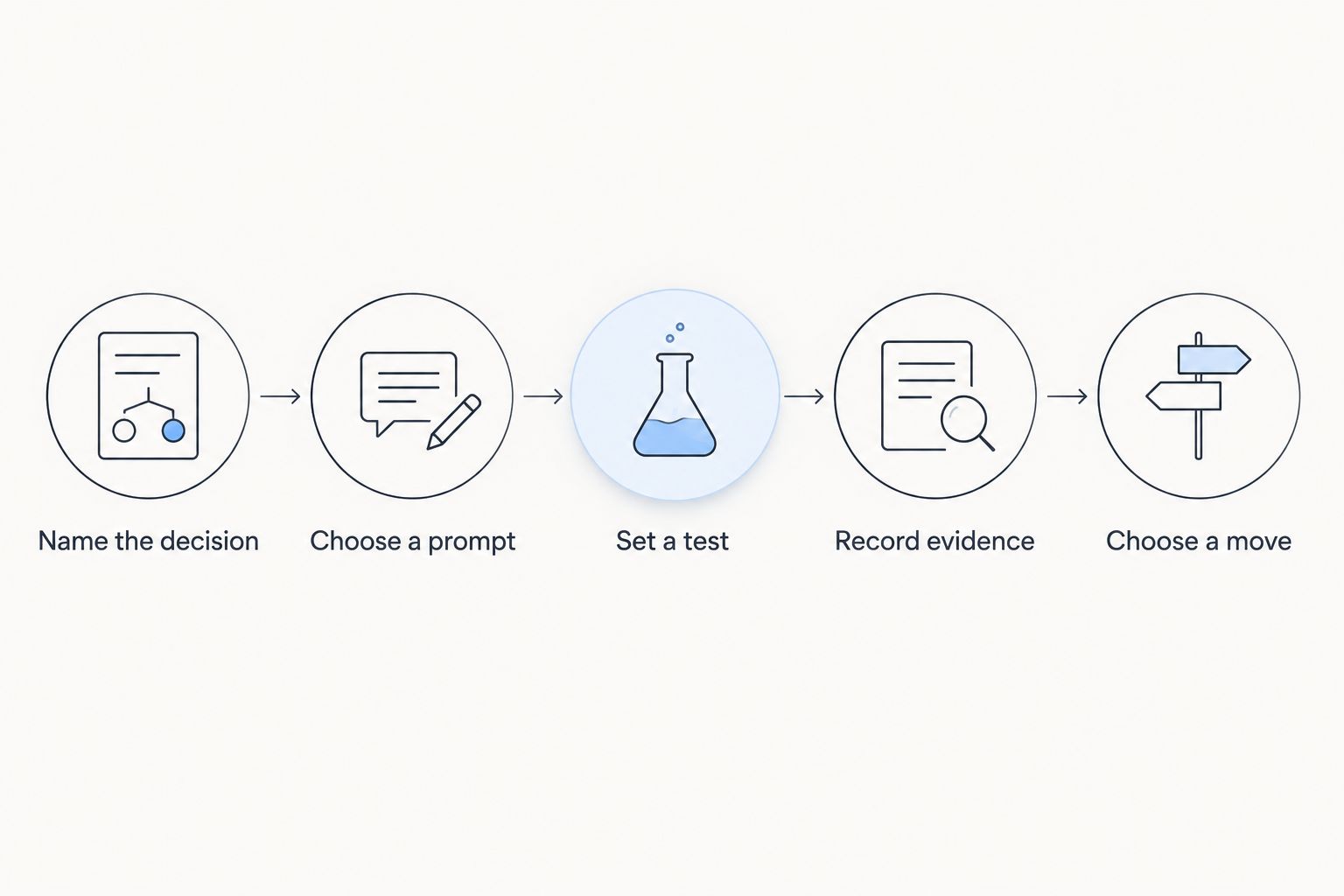
Follow this sequence:
- Name the decision. Write the choice plainly. For example, decide whether to seek more project ownership rather than whether you are destined to lead.
- Choose a prompt. Take one interpretation that relates to the decision. Leave the rest of the reading aside.
- Set a test. Choose an action within your control, such as proposing ownership of a defined deliverable.
- Record evidence. Note what happened, what you enjoyed, and what became difficult. Include evidence that contradicts your first impression.
- Choose a move. Keep, revise, or drop the idea based on the test. Do not treat the reading as the final vote.
The test needs a boundary. Owning a deliverable is specific enough to examine; becoming a completely different person at work is not. By Friday, you should have something more useful than another interpretation: an observation tied to the decision.
Example: you want more ownership
Suppose a reading prompts you to examine public responsibility. Your immediate conclusion is that you should become a manager. That jumps from a broad theme to a job title without checking the work involved.
Instead, offer to own a clearly defined handoff or project update. Notice whether you enjoy coordinating the work, making decisions, and answering for the result. Also notice the parts you dislike.
By Friday, review the experience. Wanting recognition and wanting responsibility are different preferences. The test helps you separate them without requiring a career change first.
Example: you need to price an offer
Suppose a money-pattern interpretation makes you notice that you keep revising an offer instead of presenting it. Do not turn that into a claim that your chart predicts business success. Identify the action you are avoiding.
Write a clear scope, state what the buyer receives, and ask a relevant person what remains unclear. Keep financial decisions grounded in your costs, obligations, and the buyer's response.
The useful result is a clearer offer or a concrete objection. Feeling reassured by a reading is not the same as confirming demand.
How to use career timing without treating it as a forecast
Treat timing as a planning question, not a promise about events. Ask whether you are prepared to act and what would make the action practical. Your calendar should contain tasks you can complete, not only dates you expect to be fortunate.
For a launch in 2026, review whether the offer is defined, the necessary work is finished, and you can support what you are presenting. For a career pivot, review the role's requirements, your relevant experience, and the obligations a move would affect.
A symbolic timing interpretation does not replace a real deadline or an employer's terms. Do not reject an offer solely because a reading labels the period difficult. Do not launch an unfinished offer solely because a reading labels the period favorable.
The practical question is smaller: what needs to be ready before you act? Answer that before attaching meaning to the date.
Where Astrofluence fits
Astrofluence is best for people who want structured career reflection, not career predictions. Its read brings direction, work rhythm, money pattern, and timing into a defined framework built from birth details.
The strength is structure. You can use the reading to focus a question instead of treating every frustration as evidence that your entire career is wrong. The limitation is equally important: interpretive meaning does not establish which employer will hire you or which decision will succeed.
Bring a real question to the reading. Choosing whether to pursue project ownership is more useful than asking what you were born to do. Keep responsibility for the decision with yourself, and check the suggested meaning against your work.
Can a birth chart tell you which job to choose?
No. A birth chart does not establish a single correct job for you. Use its interpretation to examine qualities of work, then compare those qualities with actual role responsibilities.
Read the job description closely. Ask what the person does on an ordinary day, what performance means, and which constraints come with the role. A title that sounds right can still contain work you do not want.
Should you change careers because of an astrology reading?
No. An astrology reading alone is not a sufficient basis for changing careers. Treat it as a prompt to investigate dissatisfaction, not as an instruction to resign.
For a 2026 pivot, choose a practical next step before committing. Talk to someone doing the work, examine the requirements, or complete a relevant sample task. Use what you learn to refine the decision.
Is combining astrology and numerology more predictive?
No. Combining astrology and numerology does not turn symbolic interpretation into a reliable career forecast. Additional frameworks provide more material to reflect on, not proof of an outcome.
Astrofluence combines chart calculations with Pythagorean numerology while treating meaning as reflective. If both readings suggest a similar theme, test that theme against your experience. Agreement between interpretations is not independent workplace evidence.
FAQ
Can astrology predict your career path accurately?
No. Astrology cannot reliably predict your career path, future employer, or promotion date. Use it to frame questions, then check those questions against skills, circumstances, and workplace evidence.
Can my birth chart tell me my ideal job?
No. A birth chart does not establish one ideal job. Compare any suggested themes with the daily responsibilities and requirements of roles you are considering.
Is career astrology useful if it cannot predict anything?
Career astrology is useful as a reflection prompt when it helps you name a specific work question. Its value is in the question and the practical test, not in a guaranteed outcome.
Does an exact birth time make a career prediction reliable?
No. Exact birth details specify calculation inputs; they do not validate a career prediction. Keep calculation precision separate from interpretive meaning.
Should I wait for a favorable astrology date to accept a job?
Do not base acceptance solely on an astrology date. Review the role, written terms, deadline, and your circumstances before deciding.
What does Astrofluence use for its career reading?
Astrofluence uses exact birth date, time, and place with the tropical zodiac, Placidus houses, and Pythagorean numerology. Its meaning layer supports career reflection, not prediction.
What can I do with a career reading by Friday?
Choose one interpretation and turn it into a small workplace test by Friday. Record what happened, including evidence that challenges the interpretation, and use that evidence to choose your next move.
One last thing
Write down what would change your mind before you run the test. If you want more responsibility, name the experience that would make you reconsider. Otherwise, it is easy to count every result as confirmation.
Your 2026 career plan does not need a cosmic verdict. It needs a clear question, an action you control, and a willingness to revise the answer. Finish one small test by Friday before asking for a bigger reading.