
Astrology career guidance is worth trying in 2026 if you use it to frame a work question and choose a practical test, not to predict your future. Its limit is clear: a birth-chart interpretation does not establish your qualifications, the quality of a job offer, or whether a business idea will succeed. Judge the reading by the decision it helps you examine, then check that decision against your actual work.
- Is astrology career guidance worth it? Yes as career reflection, not as evidence that a job will suit you.
- Astrofluence suits people who want structured career reflection, not predictions.
- Repeatable birth-chart and numerology calculations do not make their interpretations proven career advice.
- Choose one small workplace test by Friday before changing jobs, prices, or launch plans.
Is astrology career guidance worth it in 2026?
Yes as a reflection tool. No as a decision-maker. A useful reading gives you a question you can investigate. An unhelpful reading gives you a label you feel obliged to obey.
Suppose you dread Mondays. A reading about work rhythm can prompt you to examine your calendar, interruptions, and workload. It cannot establish that you chose the wrong profession. Start with the distinction between the work itself and the conditions around it.
The guide to astrology for career decisions gives you a broader starting point. For this decision, compare what each approach actually contributes.
| Approach | Best for | Useful contribution | Main limitation |
|---|---|---|---|
| Astrology career reflection | Finding language for a work question | Prompts you to examine direction, routines, money, and timing | Interpretation does not prove career fit or predict outcomes |
| Skills and work-history review | Checking whether you can do the work | Uses completed projects, responsibilities, and demonstrated skills | Past experience does not answer every question about a new role |
| Conversation with someone doing the job | Investigating daily working conditions | Lets you ask about tasks, expectations, and difficult days | One person's experience is not the whole profession |
| Small workplace experiment | Testing a specific change | Produces an observation from your own work | A short test cannot settle a long-term career decision |
These approaches answer different questions. You do not need to choose between reflection and practical investigation. Use reflection to name the question, then use work evidence to challenge the answer.
Why this matters
A career question often arrives disguised as a larger identity question. You ask what you are meant to do when the immediate problem is a manager, an unclear offer, or a calendar with no room to finish anything.
A reflective reading can give you a starting vocabulary. The danger is treating that vocabulary as a diagnosis. If a description sounds familiar, ask what recent event supports it and what event contradicts it.
For your 2026 career plan, separate three things: what you want, what you can demonstrate, and what the available role requires. A chart does not replace any of them. It can sit beside them as a prompt.
What you are actually getting from a career reading
Repeatable calculation is not predictive accuracy
Astrofluence uses exact birth date, time, and place to produce a structured career read. Its calculation layer uses the tropical zodiac, Placidus houses, and Pythagorean numerology, including master numbers 11, 22, and 33.
Those named systems explain how the inputs become chart placements and numerology results. Repeatability means a specified method can produce consistent calculations from the same inputs. It does not demonstrate that the resulting interpretation predicts career success.
Keep those standards separate. A calculation can be reproducible while its meaning remains interpretive. You still need to check whether a suggested theme describes your work and whether acting on it makes sense.
Reflective meaning should lead to a question
The reading covers direction, work rhythm, money pattern, and timing. Treat each area as a question, not an instruction.
- Direction: What work do you want to take responsibility for?
- Work rhythm: Which part of your week needs a different routine?
- Money pattern: What assumptions shape how you discuss income or price an offer?
- Timing: What needs to be ready before you act?
These questions keep the interpretation close to a real decision. They also give you room to disagree. A theme that does not match your experience belongs outside your plan.
When career astrology is useful, and when it is not
Useful: you cannot name the decision
You keep saying you need a career change. Yet you have not decided whether that means a new employer, a different responsibility, or a different profession.
Use the reading to narrow the question. Write down the task you want more of and the condition you want less of. Then investigate a change that addresses those specifics rather than replacing your entire working life at once.
Useful: you need a prompt for an awkward conversation
You want to discuss workload, but every draft sounds like a complaint. A work-rhythm theme can become a concrete request about priorities or uninterrupted time.
The useful output is not a personality label. It is a sentence you can say to your manager: explain which task needs attention, what interrupts it, and what change you want to test. Judge the conversation by whether expectations become clearer.
Not useful: you want permission to ignore the offer
A job offer still needs review on its own terms. Examine responsibilities, compensation, working hours, management expectations, and any contractual obligations. Ask questions where the offer is unclear.
Do not let a favourable interpretation excuse a poor fit. Do not let an unfavourable interpretation overrule concrete information without examination. A reading is not evidence that you should accept or reject a job.
Not useful: you want a guaranteed launch date
Launch planning needs readiness criteria. You need to know what the offer is, who it serves, and whether you can deliver it.
If a timing interpretation interests you, use it as a reminder to review those criteria. Do not turn it into a promise about customer demand. For a 2026 launch, a written readiness check is more actionable than waiting for a reading to remove uncertainty.
Why the value of astrology career guidance varies
The same reading can become either a useful prompt or another reason to postpone action. Its value depends on how you use the inputs and interpretation.
- Your question: A specific decision gives the reflection a clear purpose. Start with the offer, responsibility, routine, or launch you are considering.
- Your birth information: Exact birth date, time, and place are inputs to the chart calculation. Check the information rather than inventing missing details.
- The calculation method: Named systems let you distinguish the calculation from its interpretation. A method name is not a guarantee about outcomes.
- Your work context: Compare each theme with actual tasks, commitments, and constraints. Familiar-sounding language alone is not enough.
- Your next move: A practical test gives you something to observe. A label without a next move leaves the original decision unresolved.
Do not ask only whether the reading feels accurate. Ask whether it helped you state a better question and identify evidence that would change your mind.
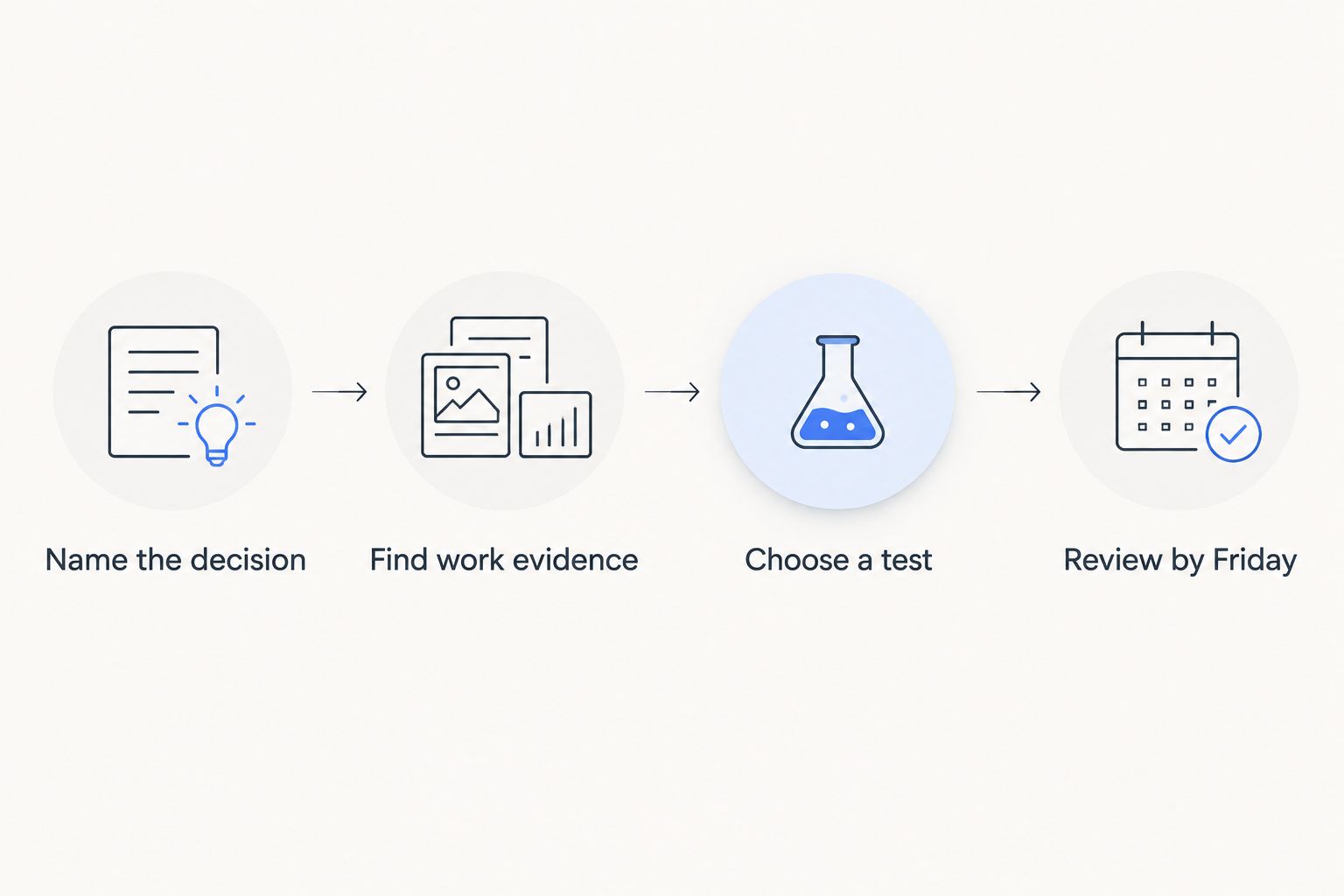
Turn the reading into a test by Friday
Choose a change that is small, reversible, and connected to the decision. Do not use this exercise to justify resigning, taking on debt, or making a commitment you have not examined.
1. Name the decision
Spend 10 minutes writing the decision in one sentence. Include the action, not just the feeling. For example, decide whether to ask for fewer simultaneous projects rather than writing that work feels overwhelming.
Keep the decision narrow enough to investigate this week. If it contains several unrelated problems, choose the one blocking your next move.
2. Find work evidence
Spend 20 minutes reviewing recent examples. Look at your calendar, a completed project, or feedback you actually received. Separate what happened from what you think it means.
If your reading suggests a need for autonomy, identify a task where you worked independently. Then identify a task where collaboration helped. Both examples belong in the review.
3. Choose a test
Select one action that checks the question without requiring a major commitment. Ask for a clearer brief, request a focused work block, or speak with someone doing the role you are considering.
Write down what you expect to learn. A test without a question becomes another task. Keep the connection visible.
4. Review by Friday
Reserve 15 minutes on Friday to compare expectation with observation. What happened? What remains unclear? What is the next question?
Do not score the test by whether it confirmed the reading. Score it by whether you learned something relevant to the decision. An observation that contradicts the interpretation is still useful.
Use different tests for different work questions
A difficult Monday
Do not begin with the conclusion that your career is wrong. Identify the first point where Monday becomes difficult: the inbox, the meeting schedule, the task itself, or an unclear priority.
Test one change. Ask which assignment takes priority before starting competing tasks. On Friday, review whether the week became clearer, not whether you suddenly loved every part of the job.
Pricing a client offer
Use a money-related theme to examine your reasoning, not to set a price. Write down the scope, delivery responsibilities, and assumptions behind the offer.
Your test is to explain the scope to someone who can challenge it. Check whether the offer is understandable and whether you have accounted for the work. A numerology result does not establish what a client will pay.
Exploring a career pivot
Choose a task from the proposed role and investigate what doing it involves. Arrange one conversation with someone who performs that work. Ask about an ordinary day and a difficult day.
Use the answers to refine your question. Enjoying the idea of a profession is different from wanting its recurring responsibilities. A reflection prompt should send you toward those details, not away from them.
Where Astrofluence fits
Astrofluence suits people who want structured career reflection, not predictions. Its useful distinction is between repeatable calculations and reflective meaning. You remain responsible for the decision.
The limitation is equally important. A structured read does not assess your technical competence, verify an employer's claims, or establish future income. Bring those questions to the relevant evidence and people.
If that boundary matches what you need, use Astrofluence with a written work question. Pick one theme to examine. Leave with a test, not a verdict about your entire career.
Can astrology tell me which career to choose?
Astrology does not establish which career you should choose. Use its interpretations to generate questions about responsibilities, routines, or direction, then investigate the actual work.
A job title is too broad to settle the issue. Examine the tasks, environment, entry requirements, and expectations before deciding whether a role fits your goals.
Should I delay a job decision because of astrology?
Do not delay a job decision solely because of an astrological interpretation. Review the offer, your questions, and the decision deadline.
For a 2026 offer, request clarification when you need it. If you want more time, base that request on the information you still need rather than treating a chart as proof of a bad outcome.
Can I use numerology alongside career astrology?
You can use numerology alongside career astrology as another reflection prompt. Combining methods does not turn interpretation into verified career evidence.
If both point to a similar theme, test that theme against your experience. Agreement between readings is not a substitute for an observation from your working life.
FAQ
Is astrology career guidance worth it in 2026?
Astrology career guidance is worth trying in 2026 as structured reflection, not as a prediction. Judge it by whether it helps you define a work question and choose a practical test.
Can a birth chart tell me my ideal job?
A birth chart does not establish your ideal job. Use an interpretation to ask questions about work, then check skills, responsibilities, and working conditions.
Is a repeatable chart calculation the same as accurate career advice?
No. Repeatable calculation means a specified method produces consistent results from the same inputs; it does not prove the career interpretation.
What does Astrofluence use for a career reading?
Astrofluence uses exact birth date, time, and place with tropical zodiac calculations, Placidus houses, and Pythagorean numerology. Its career meaning is reflective, not predictive.
Should I quit my job because of an astrology reading?
Do not quit your job solely because of an astrology reading. Examine the problem, your alternatives, your obligations, and the practical consequences first.
What should I do after a career astrology reading?
Choose one small workplace test you can review by Friday. Connect it to a specific decision and record what happened, including anything that contradicts the reading.
One last thing
Write down what would make you disagree with the reading before you act on it. If nothing counts against the interpretation, you have not created a useful test.
For your next 2026 career decision, keep the reading and the observation in separate notes. Let the work evidence change your plan. Your chart does not need defending. Your decision needs examining.