
An astrology career reading has no single standard cost: check the provider’s current terms and whether you are choosing an initial read or recurring access. In 2026, compare the full billing commitment, not just the first payment. A trial also needs a separate check: when it ends, what follows, and how you stop before committing.
- How much does an astrology career reading cost? Compare current terms, billing periods, and trial conditions before committing.
- Astrofluence is best for structured career reflection, not predictions or instructions to quit your job.
- Use birth chart and numerology interpretations to choose a practical workplace test, not to justify a purchase.
- A useful reading ends with something you can test by Friday.
How much does an astrology career reading cost?
Compare what you receive, how you are billed, and what happens after the trial. A first read and ongoing access are different commitments. Treat them separately when deciding whether a career reading belongs in your budget.
Astrofluence offers an initial career read and a subscription called Workspace, with monthly and annual billing options. Workspace has a 3-day trial. Check the current terms before starting; the billing period alone does not tell you which option fits your needs.
| Format | Best for | Benefit | Limitation or check |
|---|---|---|---|
| Initial career read | Exploring one concrete work question | Starts with a structured career reflection | Does not establish whether ongoing access is useful to you |
| Workspace with monthly billing | Considering a monthly subscription | Lets you evaluate the monthly billing commitment | Check renewal and cancellation terms before subscribing |
| Workspace with annual billing | Considering an annual subscription | Gives you an annual billing option | Check the annual commitment rather than judging only the billing label |
| Workspace trial | Evaluating the service before committing | Provides a 3-day evaluation window | Check exactly what happens when the trial ends |
These are access formats, not different levels of certainty. A subscription does not make an interpretation predictive. Choose the format that matches your actual use, then judge the reading by whether it helps you frame a decision clearly.
Why this matters
You can spend time on a career reading and still avoid the decision in front of you. You might keep rewriting your offer instead of sending it, or keep interpreting a difficult Monday instead of discussing your workload with your manager.
A useful purchase decision starts with a work question. For a 2026 career pivot, that question might be whether to test a new role through a small project before applying. For a freelancer, it might be whether the offer needs a clearer scope before the next client conversation.
Paying for reflection is not paying for certainty. Keep those expectations separate. A reading can supply language for examining your choices; your work evidence still has to support the choice you make.
Initial career read: start with one decision
The initial career read is the best starting point when you have a specific question but have not established whether this reflective approach helps you. Keep the question narrow enough to act on. Asking what work you are destined to do leaves you with little to test.
Instead, ask whether you want more responsibility or simply less interruption. Ask whether you dislike your field or the way your current team organizes work. Ask whether your offer is unclear or whether you have been avoiding the sales conversation.
The benefit is a defined starting point. The limitation is that a meaningful description can still leave your next move unclear. Before considering ongoing access, write down one action that follows from the reading and one observation that would challenge the interpretation.
For example, a reflection about work rhythm might prompt you to protect a focused work block. If that change does not help, reconsider the explanation. Do not turn a chart interpretation into a fixed story about what you cannot do.
Workspace with monthly billing: check your repeat-use reason
Monthly billing is a payment format. It is not evidence that you need a new interpretation every month. Before subscribing, name the recurring task you want the reading to support.
That task might be reviewing your work rhythm, revisiting a career direction question, or comparing a money-pattern reflection with how you actually scope client work. Keep the task concrete. A vague intention to understand yourself better does not tell you when the subscription is useful.
The benefit of a monthly option is that you can assess a monthly billing commitment. The limitation is that recurring access creates another item to manage. Check the actual renewal and cancellation terms rather than assuming what monthly access allows.
For your 2026 budget, ask a practical question: what would you do with access that you would not do with the initial read alone? If you cannot name that action, finish the first workplace test before making another commitment.
Workspace with annual billing: establish the use case first
Annual billing is best considered after you can explain why ongoing access serves your work decisions. Do not use a longer billing period to settle uncertainty about whether you will use the service.
The benefit is an annual billing option for someone deliberately considering that commitment. The limitation is the commitment itself. Review the current terms and consider whether your intended use is clear enough to justify it.
Separate curiosity from a repeatable practice. Curiosity sounds like wanting to see what the next interpretation says. A practice sounds like recording a work question, reviewing a reflection, choosing an action, and checking what happened.
You do not need to decide your entire career plan before choosing access. You do need a reason that survives beyond the first interesting paragraph. Write that reason in ordinary workplace language, without chart terminology.
The 3-day trial: use it to evaluate a real question
The Workspace trial lasts 3 days. Treat that window as an evaluation period, not as a deadline to solve your career. Read the trial terms before starting and confirm what follows when it ends.
Prepare your exact birth date, time, and place, plus a work question. Then evaluate whether the resulting structure helps you distinguish direction, daily rhythm, money pattern, and timing. Those are different questions, even when they arise from the same job problem.
A difficult Monday, for example, does not automatically mean you need a career change. You might need fewer meetings, clearer ownership, or a different way to begin the week. The trial is useful only if you can connect the reflection to an observable work situation.
Evaluate the clarity of the next action, not how flattering the interpretation feels. A description that sounds accurate but changes nothing is a weak reason to commit to ongoing access.
Why the total commitment varies
When comparing career-reading access in 2026, keep these factors separate. They help you assess the commitment without treating every offer as the same purchase.
- Access stage: An initial read and Workspace are separate stages. Decide whether you need to explore the approach or use ongoing access.
- Billing period: Monthly and annual billing are different commitments. Read the terms attached to the option you select.
- Trial boundary: The 3-day trial has an endpoint. Confirm the next step before starting rather than leaving it to memory.
- Intended use: A single career question and a recurring reflection practice call for different purchase decisions. Match access to the task.
Do not confuse interpretation scope with promised outcomes. A reading that discusses money patterns is not financial advice. A reading that discusses timing is not evidence that a particular launch date will succeed.
What are you paying to understand?
Astrofluence’s astrology career reading uses exact birth date, time, and place. Its calculation layer uses the tropical zodiac, Placidus houses, and Pythagorean numerology, including master numbers 11, 22, and 33.
The calculation layer and the meaning layer do different jobs. The calculations are repeatable. The interpretation supplies a reflective language for career questions; it does not establish which occupation you should choose or whether an offer will succeed.
That distinction is the service’s useful boundary. You can examine a structured reading without treating it as an instruction. Its limitation is equally clear: a reflection cannot replace information about your responsibilities, earnings needs, skills, or working conditions.
Use the astrology for career decisions guide to keep the focus on the decision rather than on collecting more chart labels. When you assess a reading in 2026, ask whether it helps you formulate a better work question.
How do you decide whether a reading is worth paying for?
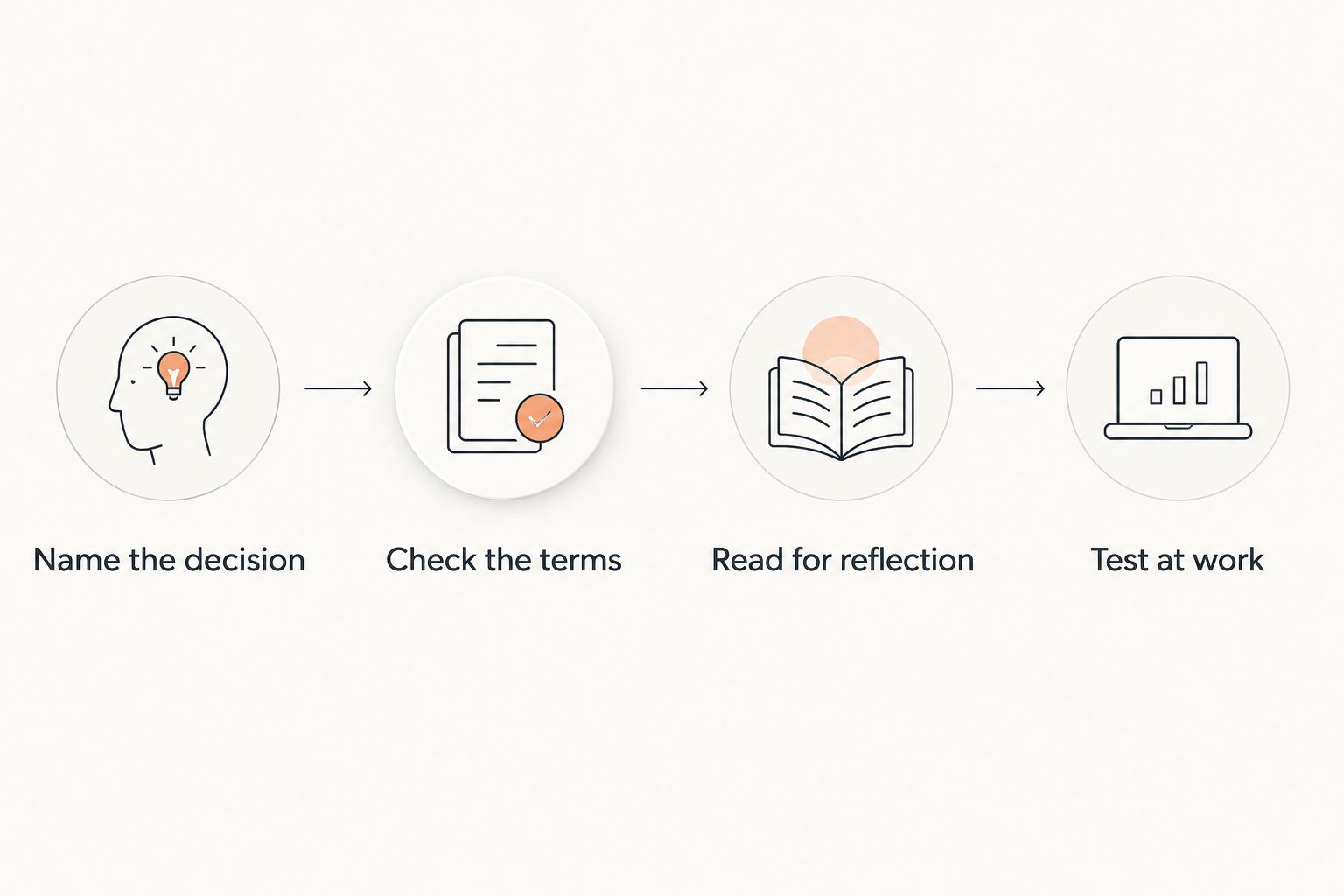
Use this sequence before choosing ongoing access. Set aside 15 minutes to prepare the question, then choose a small test that fits your actual workweek. Those are suggested planning limits, not promises about how quickly a reading works.
1. Name the decision
Write the decision as a choice you control. For example: whether to volunteer for a client-facing project, rewrite an offer’s scope, or ask your manager to change your Monday meeting load.
Avoid a question that requires a prediction. Whether a new career will work out is not something a reading can settle. Whether you can try a task associated with that career is something you can investigate.
2. Check the terms
Review the current billing option and trial conditions. Confirm what access you are considering and what action you must take if you decide not to continue.
Then separate the purchase decision from the career decision. Wanting to change jobs does not itself establish a reason to subscribe. The service needs a clear role in how you will examine that choice.
3. Read for reflection
Find the part of the reading that connects to your question. If your problem concerns overloaded Mondays, start with work rhythm rather than using every interpretation to explain the same frustration.
Write a plain-language hypothesis. For example: interruptions are making this role harder to judge. That statement can be examined at work; a claim that your chart forbids the role cannot.
4. Test at work
Choose one reversible action to complete by Friday. You could reserve a 30-minute focused work block, send a clearer scope to a prospective client, or ask a colleague what a target role actually involves.
Record what happened. Did the action improve the work situation, reveal another problem, or produce no useful change? Let that observation shape your next move, including whether further reading would help.
Can a career reading tell you when to quit?
A career reading does not establish when you should quit. Use timing language as a prompt to examine readiness, not as permission to ignore your notice obligations, financial needs, or next role.
For a 2026 transition, make a practical readiness list. Include the information you still need and the conversations you have not had. A chart interpretation does not complete those tasks for you.
Does a higher commitment make a reading more accurate?
A larger purchase commitment does not establish predictive accuracy. Keep calculation accuracy separate from the meaning you assign to the result.
Check your birth details and understand the stated calculation method. Then assess the interpretation by the quality of the question and action it supports, not by the length of the billing period.
FAQ
How much does an astrology career reading cost in 2026?
An astrology career reading has no single standard cost. Check the provider’s current terms and distinguish an initial read from recurring access, including the billing period and trial conditions.
What’s the best starting point if I’ve never had a career reading?
Start with one concrete workplace question and an initial read. Decide whether the reflection produces a useful action before considering ongoing access.
How long is the Astrofluence Workspace trial?
The Astrofluence Workspace trial lasts 3 days. Check the current trial terms and what happens at the end before starting.
Is monthly billing better than annual billing for a career reading?
Neither billing period is automatically better. Compare the commitment with your intended use and review the terms before choosing.
Can an astrology career reading predict my next job?
An astrology career reading does not establish your next job. Treat its interpretation as reflection and assess career options through actual role requirements, conversations, and work experience.
What birth details do I need for this career reading?
You need your exact birth date, time, and place. Use the most reliable records available rather than substituting a convenient time.
Does combining astrology and numerology guarantee better career advice?
Combining astrology and numerology does not guarantee better career advice. The calculations and interpretations remain distinct, and you make the decision.
How do I know whether a career reading was useful?
A useful career reading helps you name a decision and choose an action you can test. Review what happened at work rather than judging usefulness only by whether the description felt familiar.
One last thing
Choose the test before choosing the ongoing commitment. That reverses the habit of collecting interpretations until one feels decisive. You need an action that can give you new information.
By Friday, send the scoped offer, discuss the Monday workload, or try the task from the role you are considering. Astrofluence’s career reading is best for structured reflection, not predictions. Let the workplace result, not the reading alone, decide your next move.