
A career astrology reading has no single duration that applies to every format: preparing your birth details, receiving the interpretation, and using it are separate stages. Confirm the delivery window or appointment length with the provider before you book. Receiving the reading does not finish the career decision; you still need to check its suggestions against your actual work.
- How long does a career astrology reading take? Separate preparation, delivery, and reflection before planning your time.
- Astrofluence suits people who want structured career reflection, not predictions or a decision made for them.
- Exact birth date, time, and place support the chart calculation; interpretation is a separate layer.
- Choose one workplace question and one practical test you can complete by Friday.
How long does a career astrology reading take?
Plan around the provider's stated delivery time, not a general promise about astrology readings. A scheduled conversation has an appointment length. A written interpretation has a delivery window. Reading either format and deciding what to do next are different tasks.
For your 2026 career planning, ask what the stated duration includes. Does it cover collecting your birth information? Does it describe when the reading arrives, how long a conversation lasts, or how much material you receive? Those are not interchangeable answers.
The astrology for career decisions guide gives you a broader starting point. For the time question, use this breakdown:
| Stage | What you do | What to clarify |
|---|---|---|
| Preparation | Gather birth details and name your work question | Whether the provider needs anything else before starting |
| Delivery | Receive a written interpretation or attend a conversation | The delivery window or appointment length |
| Reflection | Compare the interpretation with real workplace examples | Which statements describe something you can actually observe |
| Action | Try a small change at work | What you will test and when you will review it |
Do not combine these stages into an invented total. A reading arriving quickly does not mean a career pivot becomes clear just as quickly. Your contract, finances, responsibilities, and available opportunities still need attention.
Why this matters
You might be asking about duration because you have an offer deadline, a difficult Monday, or a launch to plan. Start with that constraint. The reading belongs inside your decision process, not above it.
If an employer needs your answer before a reading arrives, work with the information you already have. Review the role, expectations, compensation, and working conditions. Do not leave a real deadline unanswered while waiting for an interpretation.
For a 2026 career change, the useful question is not only how long the reading takes. Ask whether it leaves you with a clearer question you can investigate. A finished reading is not the same thing as a finished decision.
Preparation: get your birth details and question ready
Gather your exact birth date, birth time, and birthplace before starting a reading that uses a natal chart. Keep uncertainty visible. If you do not know the time, say so rather than entering a guess as though it were confirmed.
Birth time matters to chart features such as houses and the Midheaven. That makes checking the input a separate task from interpreting the result. An interpretation cannot resolve an inaccurate input merely by sounding specific.
Then write the work question in ordinary language. Avoid asking for your entire professional future. Name the decision that is bothering you now.
Useful questions include:
- Should I investigate management, or do I prefer specialist work?
- What makes Monday difficult: the workload, the meetings, or the role itself?
- What evidence do I need before changing my client offer?
- Which part of this potential career pivot can I test without resigning?
- What needs to be ready before I choose a launch date?
A narrow question gives you a clear way to judge the interpretation. You can ask whether it helped you identify a task, a tension, or a next step. A broad description of your personality gives you less to work with.
Best for: anyone who has a specific work decision but keeps circling it. Preparation helps define the question; it does not establish which answer is correct.
Delivery: distinguish a written reading from a conversation
Ask which format you are receiving. Do not assume that the word reading means a live appointment, a written document, or a particular amount of material.
The formats create different practical questions. A document lets you return to the wording. A conversation gives you a chance to ask questions while the interpretation is being discussed. Neither format makes the meaning a prediction.
| Format | Best for | Practical advantage | Limitation to consider |
|---|---|---|---|
| Written interpretation | Reviewing wording alongside your own notes | You can revisit a passage without relying on memory | Check whether follow-up questions are included |
| Scheduled conversation | Asking for clarification during a discussion | You can ask what an unclear statement means | The appointment ends; ask how you can retain the discussion |
Before choosing a format in 2026, confirm what you receive and how delivery works. Ask about follow-up rather than assuming it exists. Ask about a recording or written summary rather than assuming either is included.
Keep the delivery question separate from the usefulness question. A long document can still leave you uncertain. A clear paragraph can give you a question worth testing. Length alone does not establish accuracy or career value.
Reflection: separate the calculation from the meaning
Astrofluence career readings use exact birth date, time, and place to structure direction, work rhythm, money pattern, and timing. Astrofluence uses the tropical zodiac, Placidus houses, and Pythagorean numerology, including master numbers 11, 22, and 33. Its calculation layer is repeatable; its meaning layer is reflective, not predictive.
Astrofluence is best for people who want structured career reflection, not a prediction about which job to take. That distinction is also its boundary. A repeatable calculation does not prove that an interpretation describes your working life.
Keep two questions separate when you read:
- Calculation: What birth information and calculation method produced this result?
- Meaning: What does this interpretation invite me to examine at work?
Suppose a passage prompts you to examine autonomy. Do not jump straight to becoming self-employed. Ask where autonomy already appears in your work, where it is restricted, and whether you actually enjoy the responsibilities that come with it.
For money questions, examine your offer, workload, and actual financial information. A money-pattern interpretation is not financial advice. For timing questions, examine readiness, obligations, and deadlines. An interpreted date does not guarantee a successful launch.
Why the time you need varies
The reading process has several moving parts. Clarifying them gives you a better planning answer than borrowing a duration from an unrelated service.
- Birth information: You need to gather the details required for the calculation and flag anything uncertain.
- Delivery format: An appointment length and a written delivery window measure different things.
- Question scope: A question about your next client offer is different from a request to examine direction, work rhythm, money, and timing together.
- Clarification: You need to know whether you can ask questions and how that works.
- Decision context: A pending offer, a career pivot, and a difficult routine require different real-world checks.
For your 2026 schedule, use these factors as questions to ask the provider. Do not turn them into a timing formula. They help explain what needs to happen, not how many minutes every person will need.
You can control the scope of your own reflection. Choose the issue you need to address first. Leave unrelated passages for another session instead of trying to settle every career question at once.
Turn the reading into a test by Friday
Use this sequence to move from an interpretation to something observable. The aim is not to prove the chart right. The aim is to learn something useful about your work.
Name the question
Write the decision without astrology language. For example: I want to know whether I enjoy helping colleagues solve problems enough to explore a management role.
That sentence gives you something to investigate. A statement such as I am meant to lead does not tell you what to do next or what evidence would change your mind.
Check the evidence
Find an example from your actual working week. When did helping a colleague feel satisfying? When did it interrupt work you preferred? Include evidence that challenges the interpretation, not just examples that fit it.
Separate the activity from the job title. Enjoying a mentoring conversation does not mean you enjoy scheduling, performance reviews, or responsibility for a team's results.
Choose the test
Choose a small action you can complete by Friday. Offer to help a colleague structure a task. Draft a clearer client offer. Rewrite a LinkedIn headline to describe the work you want to be known for.
Keep the test reversible. Do not resign, commit savings, or make a contractual promise just to follow an interpretation. The test should produce information without forcing the larger decision.
Review the result
After the test, write what happened. Record what felt useful, what was difficult, and what you would repeat. Compare that result with the question you wrote at the start.
If the test contradicts the interpretation, keep the evidence. You are examining your work, not trying to defend a reading.
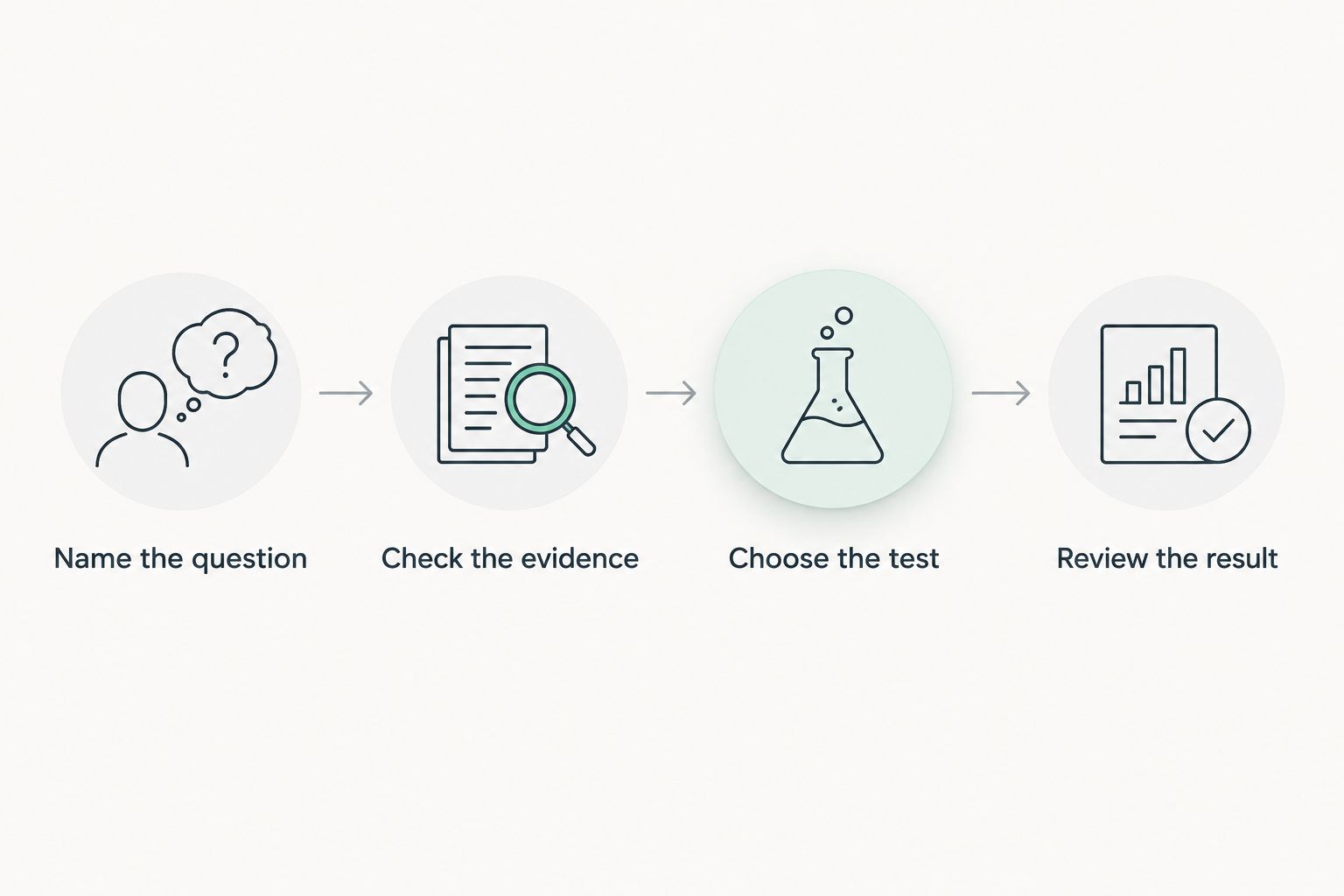
A 2026 career plan can use this process without treating a chart as an instruction. You keep responsibility for the decision. The reading supplies prompts; your workplace supplies evidence.
Does a longer career astrology reading give a better answer?
A longer career astrology reading does not establish a better answer. Assess whether the interpretation explains its terms, separates calculation from meaning, and helps you identify a practical question.
If you finish with more labels but no clearer next step, pause. Translate a passage into ordinary work language before reading further.
Should I wait for a reading before accepting a job offer?
Do not let a career astrology reading replace the checks needed for a job offer. Review the written terms, responsibilities, working conditions, and your financial position before the employer's deadline.
Use reflection to name a concern you want to investigate. Then ask the employer a concrete question rather than treating the interpretation as an answer about the role.
Can I use a reading if I do not know my birth time?
Tell the provider that your birth time is unknown and ask which parts of the reading depend on it. Do not enter an invented time and treat time-sensitive chart features as settled.
Numerology and natal-chart calculations use different inputs. Ask which interpretation is being discussed instead of assuming every part has the same limitations.
FAQ
How long does a career astrology reading take from start to finish?
There is no universal start-to-finish duration for a career astrology reading. Confirm the provider's delivery window or appointment length, then treat your own preparation and reflection as separate tasks.
Does the delivery time include time to think about my career?
A delivery time describes when you receive the reading, not when you finish a career decision. You still need to compare the interpretation with your responsibilities, opportunities, and workplace evidence.
What should I prepare before a career astrology reading?
Prepare your exact birth date, birth time, birthplace, and a specific work question. Flag uncertain birth information rather than presenting a guess as confirmed.
What is Astrofluence best for?
Astrofluence is best for structured reflection on career direction, work rhythm, money pattern, and timing. Its interpretations are not predictions or guarantees about a job, income, or launch.
Can Astrofluence tell me the right day to quit?
Astrofluence treats timing as reflective meaning, not a prediction of the right day to quit. Check your finances, contractual obligations, and next steps before making that decision.
Is a written career reading better than a live conversation?
Choose a written reading for revisiting wording and a conversation for asking questions during the discussion. Confirm follow-up arrangements and what you retain afterward; neither format establishes predictive accuracy.
What should I do after reading about my career?
Choose a small workplace test you can complete by Friday. Write what happened and use that evidence to decide whether the idea deserves further attention.
One last thing
Before you close the reading, write what would change your mind. If you think a new role suits you, name the working condition that would make it unsuitable. If you think an offer needs changing, name the client feedback you need first.
For your 2026 planning, that sentence is a useful safeguard. Choose a test that can challenge the interpretation, not just confirm it. You will leave with a question you can investigate rather than a label you have to live up to.